Mathematics - Online Test
Q1. The longest side of a triangle is three times the shortest side and the third side is 2cm shorter than the longest side if the perimeter of the triangles at least 61cm, find the minimum length of the shortest side.
Answer : Option D
Explaination / Solution:
Let the shortest side of a triangle be x cm.Then the length of the longest side is3x cm and the length of the third side is (3x-2) cm.
Given the perimeter of the triangles at least 61cm
Hence the minimum length of the shortest side = 9 cm
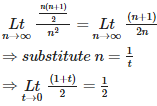
Q2. is equal to
Answer : Option C
Explaination / Solution:
Q3. In a LPP, the objective function is always
Answer : Option B
Explaination / Solution:
In a LPP, the objective function is always linear. this is because these problems are always subjected to linear inequalities, where we maximise or minimise the linear functions.
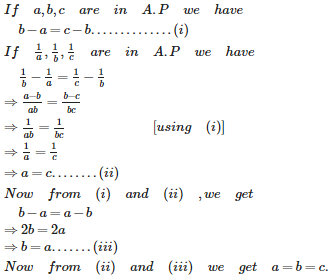
Q4. If a, b , c are in A.P. and also are in A. P., then
Answer : Option B
Explaination / Solution:
Q5. S.D. of a data is 6. When each observation is increased by 1, then the S.D. of new data is
Answer : Option D
Explaination / Solution:
so it depends only on number of observations not on individual observations.
Q6.
Let f (x) = then f (x) is strictly decreasing in
Answer : Option D
Explaination / Solution:
Hence , f is strictly increasing on [1,3].
Hence , f is strictly increasing on [1,3].
Q7. A relation R on a non – empty set A is an equivalence relation iff it is
Answer : Option B
Explaination / Solution:
By definition of Equivalence Relation,a relation is said to be equivalence if it is reflexive,symmetric and transitive
Q8. 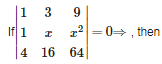
Answer : Option D
Explaination / Solution:
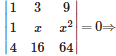 because , the value of the determinant is zero only when , the two of its rows or column are identical., Which is possible only when Either x = 3 or x = 4 .
because , the value of the determinant is zero only when , the two of its rows or column are identical., Which is possible only when Either x = 3 or x = 4 .
Q9. The distance between the parallel lines 4x + 3y + 11 = 0 and 8x + 6y = 15 is
Answer : Option A
Explaination / Solution:
Distance between two parallel lines is given by
c1 = 2 x 11 = 22 and c2 = 15 and A = 8 and B = 6
Now substituting the values we get
= 7/10
Q10. Negation of the statement ∼p→(q∨r) is
Answer : Option A
Explaination / Solution:
rules of negation ∼(p→q)≡p∧∼q
Hence ∼p∧(∼q∧∼r)