Mathematics - Online Test
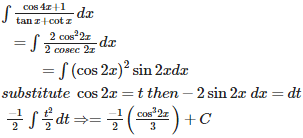
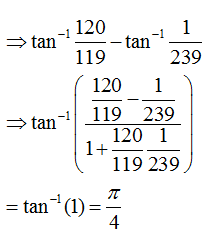
Q1.  is equal to
Answer : Option A
Explaination / Solution:


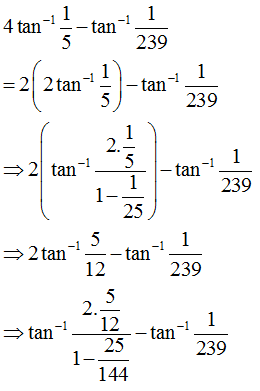
Q2. 4tan1(15)tan1(1239)=
Answer : Option C
Explaination / Solution:


Q3. The equations represent
Answer : Option B
Explaination / Solution:


Squaring both sides,we get


Putting the value of at2 i.e.  in  x = at2 we get,


or 

which is nothing but equation of parabola.
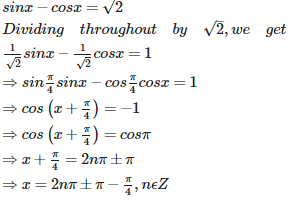

Q4. If sin x - cos x =, then x = ( n is any integer)
Answer : Option D
Explaination / Solution:


Q5. 23n-1 is divisible by
Answer : Option B
Explaination / Solution:

If n = 1 we get 7. n = 2 we get 63 which is divisible by 7........

Q6. If  and  are two independent events, then P  is equal to
Answer : Option B
Explaination / Solution:
No Explaination.


Q7. The locus of a first degree equation in x, y, z is a
Answer : Option C
Explaination / Solution:

first degree equation in x, y, z can be written in the form Ax+By+Cz+d=0 Which represent a plane Where A,B and C are the direction ratios of normal to the plane

Q8. The system of equations, x + y + z = 6, x + 2 y + 3 z = 14, x + 3 y + 5z = 20 has
Answer : Option A
Explaination / Solution:

The given system of equations does not has a solution if :
Q9. The total number of numbers from 1000 to 9999 (both inclusive) that do not have 4 different digits
Answer : Option D
Explaination / Solution:

First we will find the number of four digit numbers that can be formed using the digits 0,1,2,3,4,5,6,7,8,9  with repetition .

The first place can be filled by any of the 9 digits other than 0, and the second, third and the fourth places each  can be filled by any of the ten digits

Hence the total number of ways of forming a four digit number = 

Now we will find the number of four digit numbers in which nall the digits are distinct 

The first place can be filled by any of the 9 digits other than 0, and the second, can be filled by any of the remaining 9 digits since repetition is not possible

Similarly  third and the fourth places each  can be filled by 8 and 7 digits respectively

Hence the total number of ways of forming a four digit number  with distinct digits b= 

The total number of numbers from 1000 to 9999 (both inclusive) that do not have 4 different digits=


Q10.

Derivative of 


Answer : Option A
Explaination / Solution:

 then ,