Electronic Science - Online Test
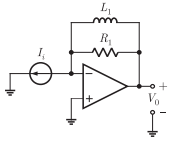
Q1. The circuit below implements a filter between the input current ii and the
output voltage v0. Assume that the opamp is ideal. The filter implemented is a
Answer : Option D
Explaination / Solution:
From diagram we can write 
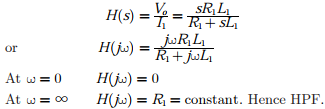
Transfer function
Q2. A solid having uppermost energy – band partially filled with electrons is called
Answer : Option D
Explaination / Solution:
No Explaination.
Q3. For a narrow base PNP BJT, the excess minority carrier concentration (ΔnE for emitter, ΔpB for base. ΔnC for collector) normalized to equilibrium minority carrier concentration (nE0 for emitter, pB0 for base, nC0 for collector) in the quasi-neutral emitter, base and collector regions are shown below. Which one of the following biasing modes is the transistor operating in?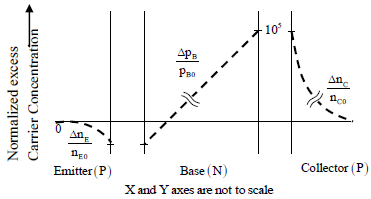
Answer : Option C
Explaination / Solution:
As per the change carrier profile, base – to – emitter junction is reverse bias and base to collector junction is forward bias, so it works in Inverse active.
Q4. X = and Y = are two 5-bit binary numbers represented in two’s complement format. The sum of X and Y represented in two’s complement format using 6 bits is
Answer : Option C
Explaination / Solution:
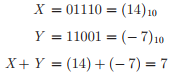

MSB of Y is 1, thus it is negative number and X is positive number
In signed two’s complements from 7 is
Q5. In series combination of capacitors, potential drops across the individual capacitors are equal to
Answer : Option A
Explaination / Solution:
When capacitors are connected in series, they have equal charge but the potential difference across them is given by .Therefore
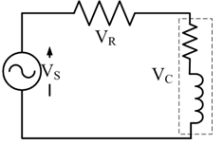
Q6. A resistance and a coil are connected in series and supplied from a single phase, 100 V, 50 Hz ac
source as shown in the figure below. The rms values of plausible voltages across the resistance (VR)
and coil (VC) respectively, in volts, are
Answer : Option D
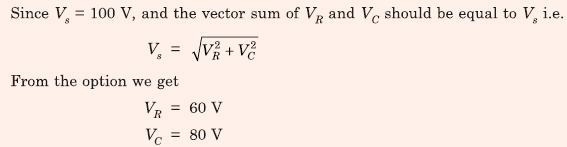
Explaination / Solution:
Q7. The wire of the potentiometer has resistance 4 ohms and length 1 m. It is connected to a cell of e.m.f. 2 volts and internal resistance 1 ohm. The p.d. across the potentiometer wire is:
Answer : Option B
Explaination / Solution:
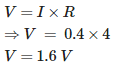
If the battery has an e.m.f E, the resitance of the potentiometer is R and internal resistance of the battery is r, then the current I flowing in the potentiometer wire is given as,
The potential difference V across the potentiometer is
Q8. A magnetic needle lying parallel to a magnetic field requires W units of work to turn it, through 600. The torque needed to maintain the needle in this position will be
Answer : Option B
Explaination / Solution:
the work done to turn a needle through an angle θ is The torque needed to maintain ..
Q9. which of the following features of atomic structure determine whether an element is diamagnetic or paramagnetic
Answer : Option D
Explaination / Solution:
No Explaination.
Q10. The number of valence electrons in a good conductor is generally
Answer : Option D
Explaination / Solution:
The electron theory states that all matter is composed of atoms and the atoms are composed of smaller particles called protons, electrons, and neutrons. The electrons orbit the nucleus which contains the protons and neutrons. It is the valence electrons that we are most concerned with in electricity. These are the electrons which are easiest to break loose from their parent atom. Normally, conductors have three or less valence electrons; insulators have five or more valence electrons; and semiconductors usually have four valence electrons.