Electronic Science - Online Test
Q1. A voltage 1000sinωt Volts is applied across YZ. Assuming ideal diodes, the voltage measured
across WX in Volts is 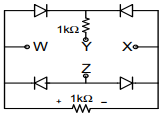
Answer : Option D
Explaination / Solution:
No Explaination.
Q2. For a parallel plate capacitor ______________ possible potential difference between the capacitor plates
Answer : Option B
Explaination / Solution:
When a dielectric is introduced between two charged plates of a capacitor having a charge Q and maintained at a potential difference of V, a reverse electric field is set up inside the dielectric due to dielectric polarization.
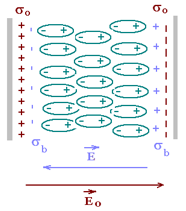
This reduces the electric field in between the plates. The potential is also reduced. Maximum potential is dependent on the charge on the plates. As the charge remains constant, the presence of the dielectric decreases the maximum potential between the plates.
This reduces the electric field in between the plates. The potential is also reduced. Maximum potential is dependent on the charge on the plates. As the charge remains constant, the presence of the dielectric decreases the maximum potential between the plates.
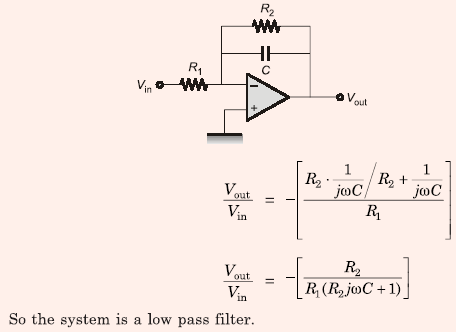
Q3. The circuit shown below is an example of a
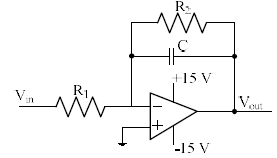
Answer : Option A
Explaination / Solution:
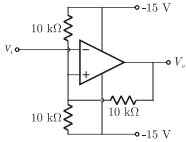
Q4. Consider the Schmidt trigger circuit shown below
A triangular wave which goes from -12 to 12 V is applied to the inverting input
of OPMAP. Assume that the output of the OPAMP swings from +15 V to -15 V.
The voltage at the non-inverting input switches between
Answer : Option C
Explaination / Solution:
Let the voltage at non inverting terminal be V1, then after applying KCL at non
inverting terminal side we have
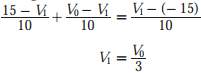
If V0 swings from -15 to +15 V then V1 swings between -5 V to +5 V.
Q5. Consider the following assertions.
S1 : For Zener effect to occur, a very abrupt junction is required.
S2 : For quantum tunneling to occur, a very narrow energy barrier is required.
Which of the following is correct ?
Answer : Option A
Explaination / Solution:
No Explaination.
Q6. Shunt resistance is added to the galvanometer
Answer : Option C
Explaination / Solution:
A shunt resistance of magnitude less than that of the galvanometer is added in parallel to the galvanometer to convert it into an ammeter. The equivalent resistance of a parallel combination is always less than the least value of the resistances in parallel. Ammeters are connected in series to the circuit to allow the entire current of the circuit to pass through them. Its resistance has to be very less- almost negligible, so that it does add on to the resistance in the circuit, thereby changing the current.
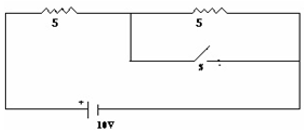
Q7. The ratio of the currents I1 when switch S is off and I2 when switch S is on is
Answer : Option B
Explaination / Solution:
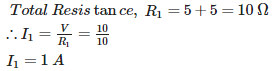
When swithch S is off, both resistances are included in the circuit.
Q8. 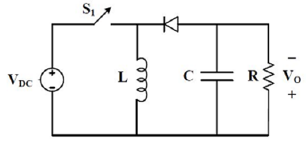
The input voltage VDC of the buck-boost converter
shown below varies from 32 V to 72 V. Assume that
all components are ideal, inductor current is
continuous, and output voltage is ripple free. The
range of duty ratio D of the converter for which the
magnitude of the steady state output voltage remains
constant at 48 V is
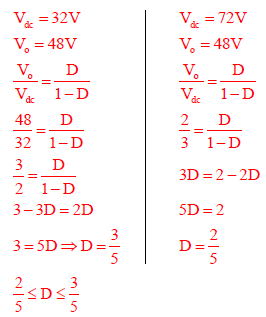
Answer : Option A
Explaination / Solution:
Q9. Consider the two cascaded 2-to-1 multiplexers as shown in the figure.
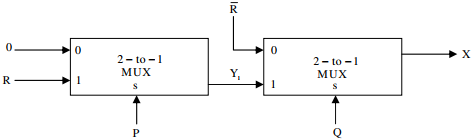
The minimal sum of products form of the output X is
Answer : Option D
Explaination / Solution:

Q10. For strong electromagnets use is made of
Answer : Option B
Explaination / Solution:
No Explaination.