Chemistry - Online Test

Q1.

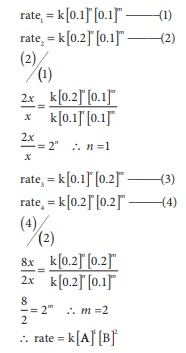
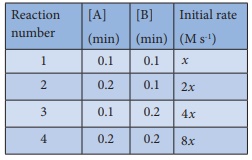
Predict the rate law of the following reaction based on the data given below

2A + B → C + 3D


Answer : Option B
Explaination / Solution:


Q2. Regarding cross-linked or network polymers, which of the following statement is incorrect?
Answer : Option D
Explaination / Solution:
No Explaination.


Q3. What is the pH of the resulting solution when equal volumes of 0.1M NaOH and 0.01M HCl are mixed?
Answer : Option D
Explaination / Solution:

x ml of 0.1 M NaOH + x ml of 0.01 M HCl

No of moles of NaOH = 0.1 × x × 10–3 =  0.1x × 10-3

No of moles of HCl = 0.01 × x × 10-3 = 0.01x × 10-3

No of moles of NaOH after mixing = 0.1x × 10-3 - 0.01x × 10-3

 = 0.09x × 10-3

Concentration of NaOH= [0.09x × 10−3 ] /  [2x × 10−3] = 0.045

[OH-] = 0.045

POH = −log (4.5 × 10⁻² )

 = 2 −log 4.5

 = 2- 0.65 = 1.35

pH = 14-1.35=12.65 


Q4. Cupellation is a process used for the refining of
Answer : Option A
Explaination / Solution:
No Explaination.


Q5.

Assertion : pure iron when heated in dry air is converted with a layer of rust.

Reason : Rust has the composition Fe3 O4
Answer : Option D
Explaination / Solution:

Both are false

i) Dry air has no reaction with iron

ii) Rust has the composition Fe2 O3 . x H2


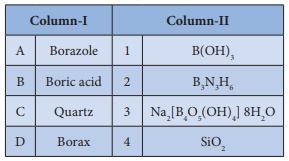
Q6. Match items in column - I with the items of column – II and assign the correct code.


Answer : Option A
Explaination / Solution:
No Explaination.


Q7.

The coagulation values in millimoles per litre of the electrolytes used for the coagulation of As2S3 are given below

(I) (NaCl)=52 (II) ((BaCl2 )=0.69 (III) (MgSO4 )=0.22

The correct order of their coagulating power is
Answer : Option A
Explaination / Solution:

coagulating power α = 1/ coagulation value

Q8. On oxidation with iodine, sulphite ion is transformed to
Answer : Option C
Explaination / Solution:
No Explaination.


Q9. HO CH2 CH2 – OH on heating with periodic acid gives
Answer : Option C
Explaination / Solution:
No Explaination.


Q10. How many moles of I2 are liberated when 1 mole of potassium dichromate react with potassium iodide?
Answer : Option C
Explaination / Solution:

K2Cr2O7 + 6KI + 7H2SO4 → 4 K2SO4 + Cr (SO4)3 + 7H2O + 3I2