Chemistry - Online Test

Q1. According to VSEPR theory, the repulsion between different parts of electrons obey the order
Answer : Option C
Explaination / Solution:
No Explaination.


Q2. A sample of 0.5g of an organic compound was treated according to Kjeldahl’s method. The ammonia evolved was absorbed in 50mL of 0.5M H2SO4. The remaining acid after neutralisation by ammonia consumed 80mL of 0.5 MNaOH, The percentage of nitrogen in the organic compound is.
Answer : Option B
Explaination / Solution:
No Explaination.


Q3. Which one of the following is used as a standard for atomic mass.
Answer : Option A
Explaination / Solution:
No Explaination.


Q4. Analkane is obtained by decarboxylation of sodium propionate. Same alkane can be prepared by
Answer : Option B
Explaination / Solution:
No Explaination.


Q5. Which of the following does not represent the mathematical expression for the Heisenberg uncertainty principle ?
Answer : Option D
Explaination / Solution:
No Explaination.


Q6. Silverpropionate when refluxed with Bromine in carbontetrachloride gives
Answer : Option C
Explaination / Solution:
No Explaination.


Q7. Among the following the least thermally stable is
Answer : Option D
Explaination / Solution:

Li2CO3 is least stable.

Q8. 25g of each of the following gases are taken at 27°C and 600 mm Hg pressure. Which of these will have the least volume ?
Answer : Option D
Explaination / Solution:

At a given temperature and pressure

Volume α no. of moles

Volume α Mass / Molar mass

Volume α 28 / Molar mass

i.e. if molar mass is more, volume is less. Hence HI has the least volume


Q9.

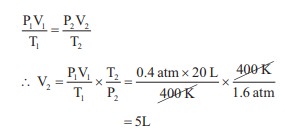
A 20 litre container at 400 K contains CO2 (g) at pressure 0.4 atm and an excess of SrO (neglect the volume of solid SrO). The volume of the container is now decreased by moving the movable piston fitted in the container. The maximum volume of the container, when pressure of CO2 attains its maximum value will be :

Given that : SrCO3 (S) SrO (S) + CO2(g)

KP = 1.6 atm 
Answer : Option B
Explaination / Solution:

Given that KP = 1.6 atm

V1 = 20 L

V2 = ?

T1 = 400 K

T2 = 400 K

KP = PCO2

PCO2= 1.6 atm

P1 = 0.4 atm. P2 = 1.6 atm


Q10. The values of ∆H and ∆S for a reaction are respectively 30 kJ mol–1 and 100 JK–1 mol–1. Then the temperature above which the reaction will become spontaneous is
Answer : Option A
Explaination / Solution:

G = H – T S

At 300K

G =30000 J mol–1 – 300 K x 100 J K–1 mol–1

G =  0

above 300 K ; ∆G will be negative and reaction becomes spontaneous.