Chemistry - Online Test
No. of electrons present in one ammonia (NH3)
molecule (7 + 3) = 10
No of molesof ammonia
=Mass/Molar mass
=1.7g/ 17 gmol-1
=0.1 mol
No of molecules present in 0.1 mol of ammonia
= 0.1x 6.022 x1025= 6.022 x 10²²
No of elec . n trons present in mol of ammonia
=10 x 6.022 x1022 = 6.022x10²³
n = 3; l = 0; ml = 0 - one s orbital
n = 3; l = 1; ml = -1, 0, 1 - three p
orbitals
n = 3; l = 2; ml = -2, -1, 0, 1, 2 -
five d Orbitals
Overall nine orbitals are possible.
Consider the reaction,
CH3CH2CH2Br + NaCN → CH3CH2CH2CN
+ NaBr
This reaction will be the fastest in
Assertion (A): If BOD level of water in a reservoir is more
than 5 ppm it is highly polluted
Reason(R)
: High biological oxygen
demand means high activity of bacteria in water
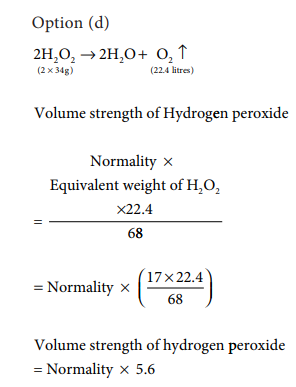
Volume strength of hydrogen peroxide = Normality of
hydrogen peroxide × 5.6
=1.5 × 5.6
=8.4
Assertion : BeSO4 is soluble in water
while BaSO4 is not