Mathematics - Online Test
Q1. The mean of 5 observations is 4.4. If three observations are 1,2 and 6 and the difference of the other two is 5, then the other two observations are:
Answer : Option B
Explaination / Solution:
Let other two numbers be x and y
Mean (x) = 4.4 =
this gives ......(1)
Also, ........(2)
Therefore from (1) and (2)
x = 9 and y = 4
Q2. Let A = {a, b, c} and R = {(a, a), (b, b), (c, c), (b, c) } be a relation on A. Here, R is
Answer : Option D
Explaination / Solution:
Any relation R is reflexive if x R x for all x ∈ R. Here ,(a, a), (b, b), (c, c)∈ R. Therefore , R is reflexive.
Q3. The equation represents all lines through the point except the line
Answer : Option D
Explaination / Solution:
The vertical lines which are parallel to Y axis has undefined slopes. Hence the slope of the line 'm' will be undefined.
Therefore the above equation of the line will represent all lines through () except the line parallel to Y- axis
Q4. Let p and q be two prepositions given by p : I take medicine, q : I can sleep then ,the compound statement ∼p→q means
Answer : Option A
Explaination / Solution:
No Explaination.
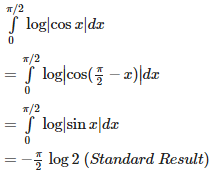
Q5. dx is equal to
Answer : Option D
Explaination / Solution:
Q6. Zero Vector
Answer : Option C
Explaination / Solution:
A vector whose initial and terminal points coincides is called Zero Vector. The magnitude of Zero Vector is also Zero.
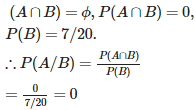
Q7. Consider the experiment of throwing a die, if a multiple of 3 comes up, throw the die again and if any other number comes, toss a coin. Find the conditional probability of the event ‘the coin shows a tail’, given that ‘at least one die shows a 3’.
Answer : Option C
Explaination / Solution:
S = {(3,1), (3,2), (3,3), (3,4), (3,5), (3,6), (6,1), (6,2), (6,3), (6,4), (6,5), (6,6), (1,H), (2,H), (4,H), (5,H), (1,T), (2,T), (4,T), (5,T)} Let A = event that coin shows a tail. i.e. A = { (1,T), (2,T), (4,T), (5,T)} and B = event that atleast one die shows 3. B = {(3,1), (3,2), (3,3), (3,4), (3,5), (3,6),(6,3)}
Q8. cos2θ is not equal to
Answer : Option B
Explaination / Solution:
is equals to 
Q9. is equal to
Answer : Option D
Explaination / Solution:
Q10. The greatest positive integer , which divides n ( n + 1 ) ( n + 2 ) ( n + 3 ) for all n ∈N , is
Answer : Option C
Explaination / Solution:
If n = 1 then the statement becomes 1x2x3x4= 24 : the consecutive natural numbers when substituted will be multiples of 24.