Mathematics - Online Test
Q1. The function f (x) = – 2 x is increasing in the interval
Answer : Option A
Explaination / Solution:
f(x) = x2- 2x
f'(x) = 2x - 2 = 2(x - 1)
So , f( x) is increasing if 2(x-1) 0 , i.e.if x 1
f'(x) = 2x - 2 = 2(x - 1)
So , f( x) is increasing if 2(x-1) 0 , i.e.if x 1
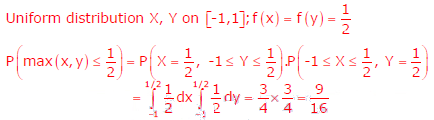
Q2. Two independent random variables X and Y are uniformly distributed in the interval [–1,1]. The probability that max[X, Y] is less than 1/2 is
Answer : Option B
Explaination / Solution:
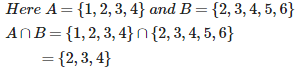
Q3. Let A = { 1,2,3,4} , B = { 2,3,4,5,6 } , then (A∩B)(A∩B)is equal to :
Answer : Option B
Explaination / Solution:
Q4. Let x,y∈R, then x + iy is a non real complex number if
Answer : Option A
Explaination / Solution:
If a complex number has to be a non real complex number then its imaginary part should not be zero ⇒iy≠0⇒y≠0
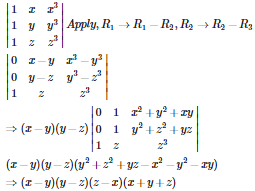
Q5. The value of the determinant 
Answer : Option D
Explaination / Solution:
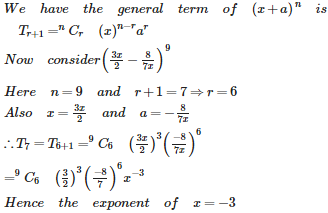
Q6. The exponent of x occurring in the term of expansion of is
Answer : Option D
Explaination / Solution:
Q7.
What is the solution set for
Answer : Option B
Explaination / Solution:
Multiplying throughout by 2,we get
So solution set is ( - 6 , 0 )
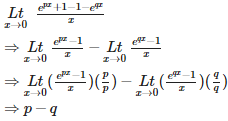
Q8. is equal to
Answer : Option A
Explaination / Solution:
Q9. Let R be the feasible region (convex polygon) for a linear programming problem and let Z = ax + by be the objective function. When Z has an optimal value (maximum or minimum), where the variables x and y are subject to constraints described by linear inequalities,
Answer : Option D
Explaination / Solution:
Let R be the feasible region (convex polygon) for a linear programming problem and let Z = ax + by be the objective function. When Z has an optimal value (maximum or minimum), where the variables x and y are subject to constraints described by linear inequalities then , optimal value must occur at a corner point (vertex) of the feasible region.
Q10. If a, 4, b are in A.P.; a, 2, b are in G.P.; then a, 1, b are in
Answer : Option D
Explaination / Solution:
As a,4,b are in AP so, ................(i)
Also a,2,b are in GP so, ab = 4...................(ii)
from (i) and (ii)
hence a, 1 , b are in HP