Mathematics - Online Test
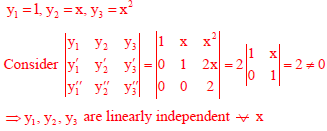
Q1. Consider the following statement about the linear dependence of the real valued functions y1 =
1, y2 = x and y3 = x2, over the field of real numbers.
I. y1, y2 and y3 are linearly independent on -1 ≤ x ≤ 0
II. y1, y2 and y3 are linearly dependent on 0 ≤ x ≤ 1
III. y1, y2 and y3 are linearly independent on 0 ≤ x ≤ 1
IV. y1, y2 and y3 are linearly dependent on -1 ≤ x ≤ 0
Which one among the following is correct?
Answer : Option B
Explaination / Solution:
Q2. Let X represent the difference between the number of heads and the number of tails obtained when a coin is tossed 6 times. What are possible values of X?
Answer : Option A
Explaination / Solution:
Let X represent the difference between the number of heads and the number of tails obtained when a coin is tossed 6 times. When a coin is tossed 6 times , we have 64 outcomes which consists of : (i) 6 heads and 0 tails (ii) 5 heads and 1 tail (iii) 4 heads and 2 tails (iv) 3 heads and 3 tails (v) 2 heads and 4 tails (vi) 1 head and 5 tails (vii) 0 head and 6 tails . Let X represents the difference between the number of heads and tails. (i) X = 6 – 0 = 6 (ii) X = 5 – 1 = 4 (iii) X = 4 – 2 = 2 (iv) X = 3 – 3 = 0 (v) X = 4 – 2 = 2 (vi) X = 5 – 1 = 4 (vii) X = 6 – 0 = 6 . Therefore , X = 6 , 4 , 2, 0 .
Q3. In a city 20 percent of the population travels by car, 50 percent travels by bus and 10 percent travels by both car and bus. Then persons travelling by a car or bus is
Answer : Option D
Explaination / Solution:
No Explaination.
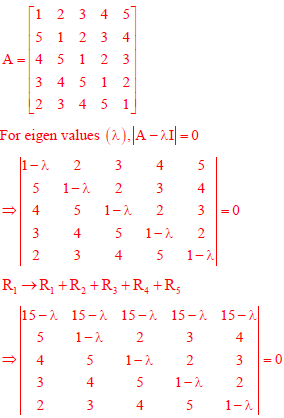
Q4. Consider the 5 × 5 matrix
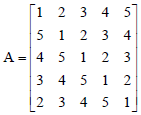
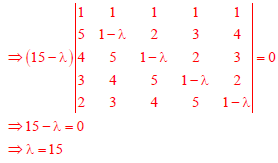
It is given that A has only one real eigen value. Then the real eigen value of A is
Answer : Option C
Explaination / Solution:
Q5. Find the mean number of heads in three tosses of a fair coin.
Answer : Option C
Explaination / Solution:
Let X is the random variable of “number of heads “ X = 0, 1, 2, 3.
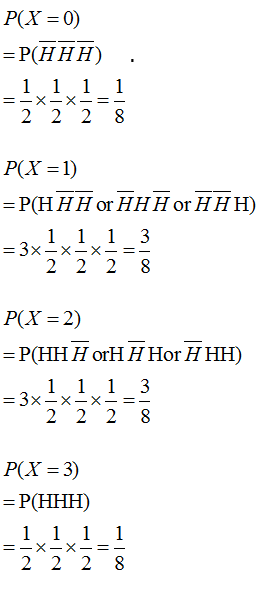
Therefore, the probability distribution is:
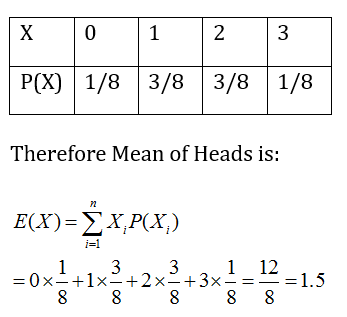
Therefore, the probability distribution is:
Q6. The minimum value of sin x + cos x is
Answer : Option D
Explaination / Solution:
No Explaination.
Q7. The rank of the matrix M =  is
is
is
Answer : Option C
Explaination / Solution:
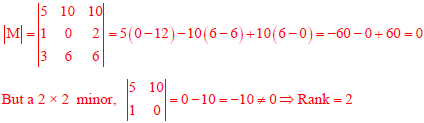
Q8. Two dice are thrown simultaneously. If X denotes the number of sixes, find the expectation of X.
Answer : Option B
Explaination / Solution:
Let A = event of getting 6 on the dice .
A = {(6,1),(6,2),(6,3),(6,4),(6,5),(6,6),(1,6),(2,6),(3,6),(4,6),(5,6)}
Let X is the random variable of “ number of sixes “.
Therefore, X = 0 , 1, ,2 .
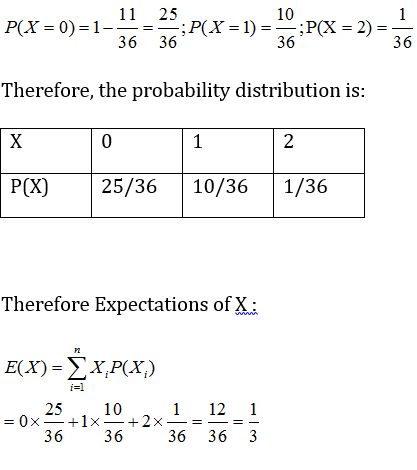
A = {(6,1),(6,2),(6,3),(6,4),(6,5),(6,6),(1,6),(2,6),(3,6),(4,6),(5,6)}
Let X is the random variable of “ number of sixes “.
Therefore, X = 0 , 1, ,2 .
Q9. A periodic signal x(t) has a trigonometric Fourier series expansion 
If  we can conclude that
we can conclude that
Answer : Option A
Explaination / Solution:
If x(t) = -x(-t) the given periodic signal is odd symmetric. For an odd symmetric signal an = 0 for all n.
If x(t) = -x(t- π/𝜔0), π/𝜔0 = T0/2 where T0 is fundamental period then the given condition satisfies half-wave symmetry.
For half-wave symmetrical signal all coefficients an and bn are zero for even value of n.
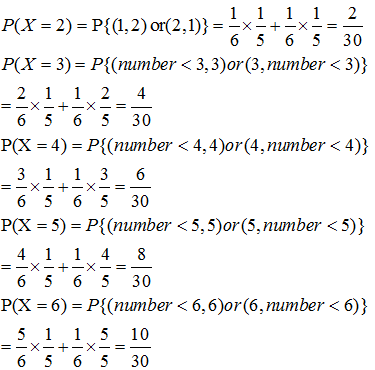
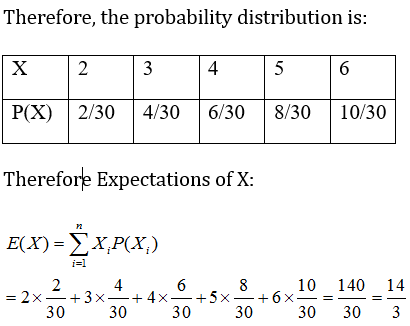
Q10. Two numbers are selected at random (without replacement) from the first six positive integers. Let X denote the larger of the two numbers obtained. Find E(X).
Answer : Option B
Explaination / Solution:
First 6 positive integers are 1,2,3,4,5,6. As 1 is the smallest positive integer. Therefore , X = 2,3,4,5,6.