Electrical Engineering - Online Test
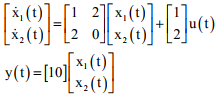
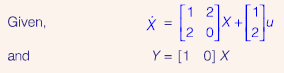
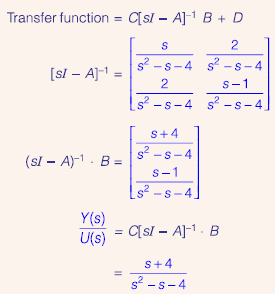
Q1. The transfer function of the system Y(s)/U(s) whose state-space equations are given below is:
Answer : Option D
Explaination / Solution:
Q2. The system represented by the input-output relationship 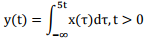 is
is
is
Answer : Option B
Explaination / Solution:
No Explaination.
Q3. Consider an angle modulated signal  The average power of x(t) is
The average power of x(t) is
Answer : Option B
Explaination / Solution:
No Explaination.
Q4. 
A 50Hz synchronous generator is initially connected to a long lossless transmission line which is open circuited at the receiving end. With the field voltage held constant, the generator is disconnected from the transmission line. Which of the following may be said about the steady state terminal voltage and field current of the generator?
Answer : Option A
Explaination / Solution:
No Explaination.
Q5. 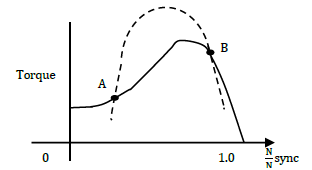
A 3-phase squirrel cage induction motor supplied from a balanced 3-phase source drives a mechanical load. The torque-speed characteristics of the motor (solid curve) and of the load (dotted curve) are shown. Of the two equilibrium points A and B, which of the following options correctly describes the stability of A and B?
Answer : Option A
Explaination / Solution:
No Explaination.
Q6. A good transconductance amplifier should have
Answer : Option C
Explaination / Solution:
A good trans conductance amplifier should have high input and output resistance.
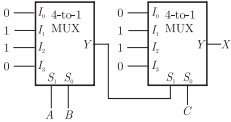
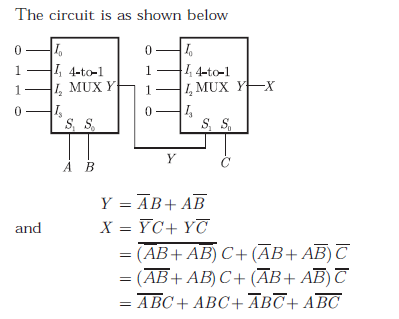
Q7. In the following circuit, X is given by
Answer : Option A
Explaination / Solution:
Q8. A region of negative differential resistance is observed in the current voltage characteristics of a silicon PN junction if
Answer : Option A
Explaination / Solution:
In case of Tunnel diode formed by PN junction, tunnel diode gives negative resistance and works in forward bias, and in tunnel diode both N and P regions are heavily doped.
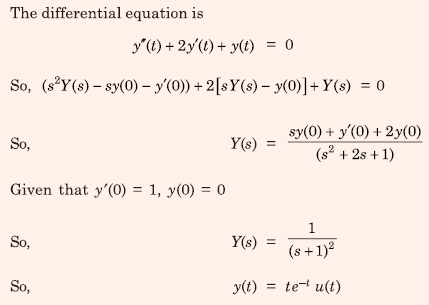
Q9. The solution of the differential equation, for  with initial conditions y(0) = 0 and
  is (u(t) denotes the unit step function),
with initial conditions y(0) = 0 and is (u(t) denotes the unit step function),
Answer : Option A
Explaination / Solution:
Q10. The graph associated with an electrical network has 7 branches and 5 nodes. The number of independent KCL equations and the number of independent KVL equations, respectively, are
Answer : Option D
Explaination / Solution: