Mathematics - Online Test
Q1. The lines ix + my + n = 0 , mx + ny + l = 0 and nx + ly +m = 0 are concurrent if
Answer : Option B
Explaination / Solution:
The required condition for concurrency is a3(b1c2 - b2c1) + b3(c1a2 - c2a1) + c3(a1b2 - a2b1) = 0
Here a1 = l, a2 =m, a3 = n and b1 = m, b2 = n, b3 = l and c1 = n, c2 = l and c3 = m
Substituting the values we get
n(ml - n2) + l(nm - l2) +m(ln - m2) = 0
This implies l3 + m3 + n3 - 3lmn = 0
That is (l + m+ n)(l2 + m2 + n2 -lm -mn - nl) = 0
This implies l + m + n = 0
Q2. The contrapositive of the statement “ if then I get first class” is
Answer : Option C
Explaination / Solution:
p:
q:I get first class
the contrapositive of . hence the answer is If I do not get a first class , then
Q3. is equal to
Answer : Option D
Explaination / Solution:
Q4. Write down a unit vector in XY-plane, making an angle of 30° with the positive direction of x-axis.
Answer : Option D
Explaination / Solution:
Let be a unit vector in XY plane,making angle 300 with positive X axis,so we have the vector as
is the required vector.
is the required vector.
Q5. is satisfied by ,
Answer : Option C
Explaination / Solution:
if ,
i.e. if ,
i.e. if ,
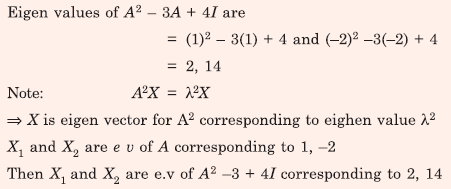
Q6. Let the eigenvalues of a 2 x 2 matrix A be 1, -2 with eigenvectors x1 and x2 respectively. Then the eigenvalues and eigenvectors of the matrix A2 − 3A + 4I would, respectively, be
Answer : Option A
Explaination / Solution:
Q7. The line 3x – 4y = 0
Answer : Option A
Explaination / Solution:
After completing the square,we get
so center is (0,0) and radius is 5 units.
As the normal should pass through the centre of the circle, center should satisfy the equation of normal
so 3x – 4y = 0 is the equation of normal as (0,0) satisfy this equation.
Q8. where
Answer : Option A
Explaination / Solution:
is valid only if , i.e. if
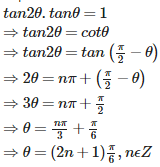
Q9. The solution of tan 2 θ tan θ = 1 is
Answer : Option D
Explaination / Solution:
Q10. The sum of the terms in the nth bracket of the series 1 + (2+3+4) + (5+6+7+8+9) ….is
Answer : Option D
Explaination / Solution:
replace n = 1 we get the first term and n = 2 we get the sum of first two terms....