Mathematics - Online Test
Q1. Let f(x) = x – [x], then f ‘ (x) = 1 for
Answer : Option B
Explaination / Solution:
f(x) = x - is derivable at all x R – I , and f ‘(x) = 1 for all x R – I
Q2. The number of tangents to the circle through the point ( - 1, 2) is
Answer : Option A
Explaination / Solution:
The given equation of the circle can be written as
(x-1)2 - 1 + (y- 2)2 - 4 = 0
(x - 1)2 + (y + 2)2 = 5
This implies the radius is and the centre is (1,-2)
The given point is (-1,2)
The distance between the centre of the circle and the given point is
=
Sice this is greater than the radius, the point lies outside the circle. Hence two tangents can be drawn.
Q3. Let that for all natural numbers n. also , if P ( m ) is true , m N , then we conclude that
Answer : Option D
Explaination / Solution:
This criteria is from the basic principle of mathematical induction.
Q4. In a triangle ABC, cosec A (sin B cos C + cos B sin C) equals
Answer : Option D
Explaination / Solution:
cosecA(sinBcosC+cosBsinC)=cosecA.sin(B+C)[∵A+B+C=π]=sin(B+C)sinA=sin(π−A)sinA=sinAsinA=1
Q5. Find the shortest distance between the lines : 

Answer : Option D
Explaination / Solution:
On comparing the given equations with:
, we get:
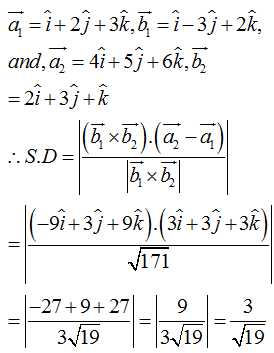
, we get:
Q6. The number of ways in which n ties can be selected from a rack displaying 3n different ties is
Answer : Option B
Explaination / Solution:
The number of selections of r objects from the given n objects is denoted by and we have
Now n ties can be selected from a rack displaying 3n different ties in different ways
Q7. The number of spheres of a given radius r and touching the coordinate axes is
Answer : Option A
Explaination / Solution:
No Explaination.
Q8. From the matrix equation AB = AC we can conclude B = C, provided
Answer : Option D
Explaination / Solution:
Here , only non- singular matrices obey cancellation laws.
Q9. Find a particular solution of = 1; y =0 when x =2
Answer : Option A
Explaination / Solution:
Here y =0 when x =2
Hence
Q10. The smallest positive integer n for which is
Answer : Option D
Explaination / Solution:

By inspection we have the smallest positive integer such that is n=4.