Mathematics - Online Test
Q1. If a line is drawn through the origin and parallel to the line x – 2y + 5 = 0 , its equation is
Answer : Option D
Explaination / Solution:
If the line is parallel to the given line x-2y + 5 =0,
then the required line will have same slope
Hence the equaion of the given line is x-2y+k=0
since it passes through the origin,
0+0+k=0
Therefore k=0
Hence the equation of the required line is x-2y=0 or x=2y
Q2. ∼(p∨q)∨(∼p∧q) is logically equivalent to
Answer : Option A
Explaination / Solution:
distributive law
since
since
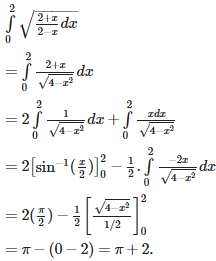
Q3. is equal to
Answer : Option C
Explaination / Solution:
Q4. Negative of a Vector is a
Answer : Option C
Explaination / Solution:
egative of is equal to - , i.e. A vector whose magnitude is the same as that of ,but direction is opposite to that of .
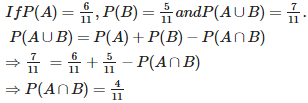
Q5. If P(A) =, P(B) = and P(A ∪ B) = find P(A∩B)
Answer : Option A
Explaination / Solution:
Q6. The period of the function f(x)=cos 4x + tan 3x is
Answer : Option D
Explaination / Solution:
f(π)=(cos4π+tan3π)gives the same value as f (0) .Therefore,the period of the function is π
Q7. The inequality is true
Answer : Option C
Explaination / Solution:
Since when n = 1 , we get the inequality as 1>1, which is not true. also for n = 2 , we get 2>2, which is false. Hence the given statement is true for n>2
Q8. The function f (x) = 1 + | sin x l is
Answer : Option D
Explaination / Solution:
is not derivable at those x for which is continuous everywhere (being the sum of two continuous functions)
Q9.
is a circle. The points (0, 0) and ( 1, 8) lie
Answer : Option B
Explaination / Solution:
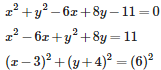
so the center is (3,-4) and radius is 6 units.
distance between center and (0,0) is  units which is less than the radius so it lies inside the circle
units which is less than the radius so it lies inside the circlewhereas the distance between center and (1,8) is  which is greater than the radius so it lies outside the circle
which is greater than the radius so it lies outside the circle
Q10. What is the order of differential equation :
Answer : Option D
Explaination / Solution:
Order = 3.Since the third derivative is the highest derivative present in the equation. i.e.