Mathematics - Online Test
Q1. A student was asked to prove a statement P ( n ) by method of induction . He proved that P ( 3 ) is true and that P(n)⇒P(n+1) for all natural numbers n . On the basis of this the criteria applied on n for P ( n ) to be true
Answer : Option A
Explaination / Solution:
Since by the principle of mathematical induction if p( n ) is true for n = 3 then that will be the minimum point to be considered for the process.Also that P ( n ) ⇒P(n+1)
Q2. is equal to
Answer : Option B
Explaination / Solution:
( using L’Hospital Rule)
Q3. The value of k, such that the equation represents a point circle, is
Answer : Option B
Explaination / Solution:
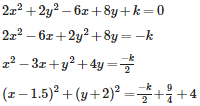
which gives radius  for a point circle radius should be zero.
for a point circle radius should be zero.hence 
solving which we get k=
Q4. Determine order and degree (if defined) ofcos() = 0
Answer : Option B
Explaination / Solution:
order = 2, degree not defined, because the function dy/dx present in angle of cosine function.
Q5. A fair dice is rolled n times. The number of all the possible outcomes is
Answer : Option C
Explaination / Solution:
each time there are 6 possibilities, therefore for n times there are 6n possibilities.
Q6.
Equation of a line through a point and having direction cosines l, m, n is
Answer : Option A
Explaination / Solution:
Equation of a line through a point (x1, y1, z1) and having direction cosines l, m, n is given by :
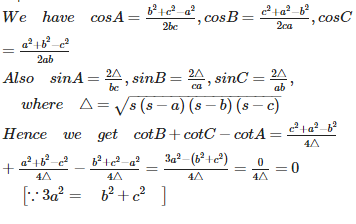
Q7. If then cot B + cot C - cot A =
Answer : Option C
Explaination / Solution:
Q8. The area of the region between the curve y = 4 – and the x –axis is equal to
Answer : Option B
Explaination / Solution:
y = And
Required area:
= = =
Required area:
= = =
Q9. The equation xy = 0 in three dimensional space represents
Answer : Option B
Explaination / Solution:
since xy=0 implies x=0 or y=0.i.e YZ plane or XZ plane.Hence it represents a pair of planes at right angles
Q10. A square matrix A is called idempotent if
Answer : Option C
Explaination / Solution:
If the product of any square matrix with itself is the matrix itself , then the matrix is called Idempotent.