Mathematics - Online Test
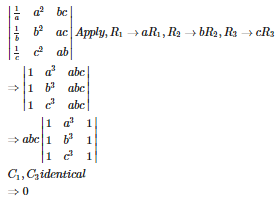
Q1.  is equal to
is equal to
Answer : Option C
Explaination / Solution:
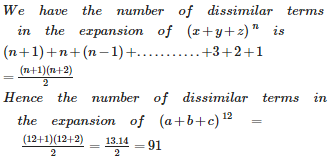
Q2. The number of dissimilar terms in the expansion of is
Answer : Option C
Explaination / Solution:
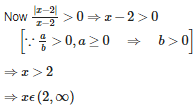
Q3. What is the solution set for ?
Answer : Option B
Explaination / Solution:
We have [ |x| or absolute value of x is always positive or zero but never negative ]
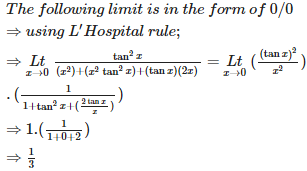
Q4. is equal to
Answer : Option B
Explaination / Solution:
Q5. Let R be the feasible region for a linear programming problem,and let Z = ax + by be the objective function. If R is bounded, then the objective function Z has both a maximum and a minimum value on R and
Answer : Option D
Explaination / Solution:
Let R be the feasible region for a linear programming problem,and let Z = ax + by be the objective function. If R is bounded, then the objective function Z has both a maximum and a minimum value on R and each of these occurs at a corner point (vertex) of R.
Q6. pth term of an A.P. is q and qth term is p, its (p+ q)th term is
Answer : Option B
Explaination / Solution:
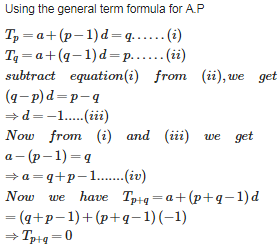
Q7. Coefficient of correlation between the observations ( 1, 6 ) , ( 2 , 5 ) , ( 3 , 4) , ( 4 , 3 ) , ( 5 , 2 ) , ( 6 , 1 ) is
Answer : Option A
Explaination / Solution:
use,r(x,y)=1n∑i=1n(Xi−X¯)(Yi−Y¯)1n∑i=1n(Xi−X¯)2√1n∑i=1n(Yi−Y¯)2√
Q8. Let A = {1, 2, 3}. Which of the following is not an equivalence relation on A ?
Answer : Option A
Explaination / Solution:
A relation R on a non empty set A is said to be reflexive iff xRx for all x R . A relation R on a non empty set A is said to be symmetric iff xRyyRx, for all x , y R .
A relation R on a non empty set A is said to be transitive iff xRy and yRzxRz, for all x R. An equivalence relation satisfies all these three properties. .
None of the given relations satisfies all three properties of equivalence relation.
A relation R on a non empty set A is said to be transitive iff xRy and yRzxRz, for all x R. An equivalence relation satisfies all these three properties. .
None of the given relations satisfies all three properties of equivalence relation.
Q9. The distance between the parallel lines 3x + 4y + 13 = 0 and 3x + 4y – 13 = 0 is
Answer : Option A
Explaination / Solution:
Distance between parallel lines is given by
Now substituting the values we get,
=
Q10. Let p and q be two prepositions given by p : A parallelogram is a rhombus. q : The diagonals are at right angles. The compound proposition “ A parallelogram is a rhombus iff its diagonals are at right angles “ is represented by
Answer : Option B
Explaination / Solution:
iff means a double implication statement so symbolic form has ↔