Mathematics - Online Test
Q1.
is a vector joining two points P(x1, y1, z1) and Q(x2, y2, z2).If ,Direction cosines of are
Answer : Option A
Explaination / Solution:
since we know Direction cosines of a line are coefficient of i,j,k of a unit vector along that line,first find a vector then to convert it unit vector divide by its magnitute || the coefficient of this unit vector will be
Q2. If the sides of a triangle are 13, 7, 8 the greatest angle of the triangle is
Answer : Option C
Explaination / Solution:
Let the sides of the triangle be a=13,b=7 and c=8.
Since a is the longest side the greatest angle is A.
Using Cosine rule, we have
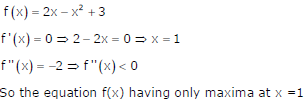
Q3. The function f(x) = 2x - x2 - x3 + 3 has
Answer : Option C
Explaination / Solution:
Q4. The area enclosed between the curves y = ,x- axis and two ordinates x = 1 to x = 2 is [ in square units ]
Answer : Option C
Explaination / Solution:
Required area :
= = = = == sq units
Q5. The medians of a triangle are concurrent at the point called
Answer : Option C
Explaination / Solution:
The centroid is the point of concurrency of the medians of the triangle.it is a point of centre of gravity of triangle
Q6. is the matrix
Answer : Option B
Explaination / Solution:
It is an identity matrix with the order 2*2,
Q7. Let f be a real valued function defined on (0, 1) ∪(2, 4) such that f ‘ (x) = 0 for every x, then
Answer : Option D
Explaination / Solution:
f ‘ (x) =0 f (x) is constant in ( 0 , 1 ) and also in ( 2, 4 ). But this does not mean that f ( x) has the same value in both the intervals . However , if f ( c ) =f ( d ) , where c ( 0 , 1 ) and d ( 2, 4) then f ( x ) assumes the same value at all x ( 0 ,1 ) U (2, 4 ) and hence f is a constant function.
Q8. If A is any set , then
Answer : Option A
Explaination / Solution:
{tex}A \cup A' = \{ x \in U:x \in A\} \cup \{ x \in U:x \notin A\} = U{/tex}
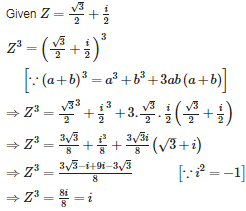
Q9. If Z = then equals
Answer : Option C
Explaination / Solution:
Q10. If A, B be two square matrices such that |AB|=O, then
Answer : Option A
Explaination / Solution:
If A B be two square matrices such that AB=O, then, |AB|=O⇒|A||B|=O⇒either|A|=0,or|B|=0