Mathematics - Online Test
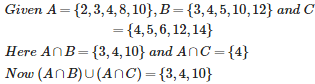
Q1. If A = { 2,3,4,8,10 } ,B = { 3,4,5,10,12 } and C = { 4,5,6,12,14 } , then (A∩B)∪(A∩C) then
Answer : Option C
Explaination / Solution:
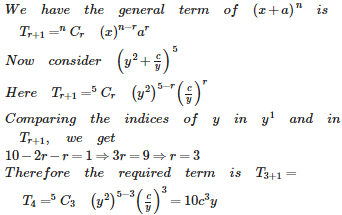
Q2. The coefficient of y in the expansion of is
Answer : Option C
Explaination / Solution:
Q3. The area bounded by y = log x , the x – axis and the ordinates x = 1 and x = 2 is
Answer : Option C
Explaination / Solution:
Required area :
= = == = = =
= = == = = =
Q4. Which of the following is correct ?
Answer : Option A
Explaination / Solution:
Given 0 -7
Multiplying throughout by -1,we get0 7 [ When both sides of an inequality are multiplied by a negative number ,then the sign of inequality is reversed]
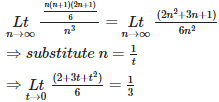
Q5. is equal to
Answer : Option B
Explaination / Solution:
Q6. A matrix has eigenvalues –1 and –2. The corresponding eigenvectors are  respectively. The matrix is
respectively. The matrix is
Answer : Option D
Explaination / Solution:
No Explaination.
Q7. The optimal value of the objective function Z = ax + by may or may not exist, if the feasible region for a LPP is
Answer : Option A
Explaination / Solution:
The optimal value of the objective function Z = ax + by may or may not exist, if the feasible region for a LPP is unbounded. This is because the maximum or minimum value of the objective function may not exist.Even if it exists it must occur in a corner pointof the feasible region.
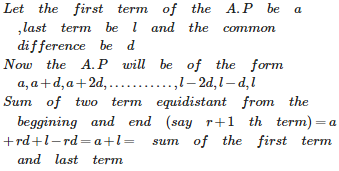
Q8. The sum of terms equidistant from the beginning and end in A.P. is equal to
Answer : Option D
Explaination / Solution:
Q9. The most stable measure of central tendency is
Answer : Option C
Explaination / Solution:
because takes into account every value in the given set of data to provide the average
Q10.
Let and x, y R} be a relation in R. The relation R is
Answer : Option B
Explaination / Solution:
A relation R on a non empty set A is said to be symmetric if fx RyyRx, for all x , y R Clearly is same as for all x , y R. Therefore ,R is symmetric.