Mathematics - Online Test
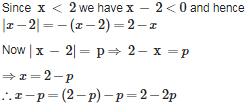
Q1. If | x − 2|= p, where x < 2, then x - p =
Answer : Option D
Explaination / Solution:


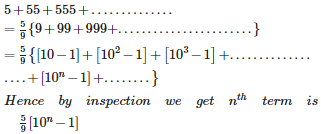
Q2. The nth term of the sequence 5 + 55 + 555 + …. is
Answer : Option B
Explaination / Solution:


Q3. If the two lines of regression are 2x + y =7 and x + 2y = 7, then ρ(X,Y) is equal to
Answer : Option B
Explaination / Solution:

let us assume that 2x + y =7 and x + 2y = 7 are lines of regression of y on x and x on y respectively

therefore, 

but sign of p will be same as  and 

hence, 
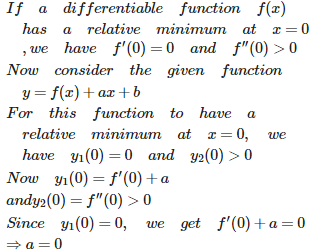

Q4. If a differentiable function f (x) has a relative minimum at x = 0, then the function y = f (x) + a x + b has a relative minimum at x = 0 for
Answer : Option B
Explaination / Solution:


Q5. Corner points of the feasible region for an LPP are (0, 2), (3, 0), (6, 0), (6, 8) and (0, 5).Let F = 4x + 6y be the objective function. Maximum of F – Minimum of F =
Answer : Option A
Explaination / Solution:

Here the objective function is given by : F = 4x +6y .

Corner points

Z = 4x +6 y

(0, 2 )

12………………..(Min.)

(3,0)

12………………….(Min.)

(6,0 )         

24

(6 , 8 )

72

(0 , 5 )

30

Maximum of F – Minimum of F = 72 – 12 = 30 .


Q6. The domain of definition of the function y=f(x)= √−x is :
Answer : Option A
Explaination / Solution:

y is defined if −x ⩾ 0 ,i.e.if x ⩽ 0, i.e. x ∈(−∞,0].

Q7. If A is a square matrix of order 2 , then det (adj A) =
Answer : Option C
Explaination / Solution:

Let A be a square matrix of order 2 then , because  where n is the order of square matrix.

Q8.

The equations of the lines through ( 1 , 1 ) and making angles of  with the line x + y = 0


Answer : Option C
Explaination / Solution:

If the lines make equal angles of 450 with the given line, x+y =0.

Then these lines must be perpendicular with each other.

This is possible only when the two lines are parallel to X axis and Y axis.

That is the equations should be x = a constant and y  = a constant.

Since it passes through (1,1)

The equations should be x = 1 or x-1=0 and y=1 or y-1 =0

Q9. p∧(q∧r) is logically equivalent to
Answer : Option D
Explaination / Solution:

Associative law

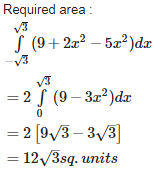
Q10. The area bounded by the parabolas y = 
Answer : Option D
Explaination / Solution: