Mathematics - Online Test
Q1. For the spherical surface x2 + y2 + z2 = 1, the unit outward normal vector at the point (1/√2, 1/√2, 0)is given by
Answer : Option A
Explaination / Solution:
To find the direction of normal, take the gradient i.e.
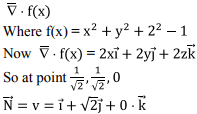
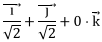
8 unit vector will become
Q2. At x = 0, the function f(x) = x3 + 1 has
Answer : Option D
Explaination / Solution:
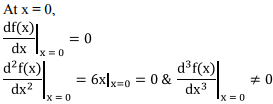
So, x = 0 is point of inflexion
Q3. For the matrix  ONE of the normalized Eigen vectors is given as
ONE of the normalized Eigen vectors is given as
Answer : Option B
Explaination / Solution:

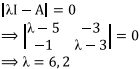


To find eigenvector, first find Eigen-values by solving equation
So for λ = 2, the eigenvector 15
Normalized Eigen Vector
Q4. The inverse Laplace transform of the function F(s) = 1/(s(S+1)) is given by
Answer : Option D
Explaination / Solution:
No Explaination.
Q5. +2y + z = 4
2x + y + 2z = 5
x - y + z = 1
The system of algebraic equation given above has
Answer : Option C
Explaination / Solution:
No Explaination.
Q6. Consider the differential equation  with the boundary conditions of y(0) = 0 and y(1) = 1. The complete solution of the differential equation is
with the boundary conditions of y(0) = 0 and y(1) = 1. The complete solution of the differential equation is
Answer : Option A
Explaination / Solution:
No Explaination.
Q7. A box contains 4 red balls and 6 black balls. Three balls are selected randomly from the box one
after another, without replacement. The probability that the selected set contains one red ball and
two black balls is
Answer : Option D
Explaination / Solution:
No Explaination.
Q8. Let X be a nominal variable with mean 1 and variance 4. The probability P(X < 0) is
Answer : Option B
Explaination / Solution:
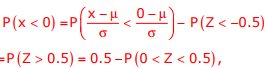
which is greater than zero and less than 0.5
Q9. Choose the CORRECT set of functions, which are linearly dependent.
Answer : Option C
Explaination / Solution:
No Explaination.
Q10. The following surface integral is to be evaluated over a sphere for the given
steady velocity vector field, F = xi + yj + zk defined with respect to a Cartesian
coordinate system having i, j, and k as unit base vectors.

Where S is the sphere, x2 + y2 + z2 = 1 and n is the outward unit normal vector to
the sphere. The value of the surface integral is
Answer : Option A
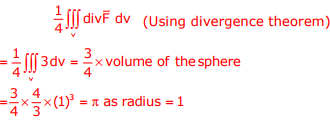
Explaination / Solution: