Mathematics - Online Test
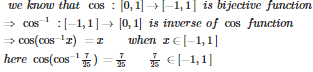
Q1. cos(cos1(725))=
Answer : Option D
Explaination / Solution:


Q2. The line y = m x + c, touches the parabola  if
Answer : Option D
Explaination / Solution:

y = m x + c ---(i)

 ---(ii)

putting the value of y from (i) in (ii), we get

=> 

here

discriminant =

                     =

when discriminant >0 line touches parabola at two points,

when discriminant < 0 line do not  touches parabola and

when discriminant = 0 line touches parabola at one point

and we know that tangent is a line that touches the curve at exactly one point

so putting discriminat = 0 and solving

we get 


on putting the value of y from line in the parabola and solving for equal roots.


Q3.

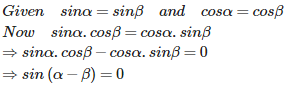
If  sinα=sinβ and cosα=cosβ , then


Answer : Option A
Explaination / Solution:


Q4. For all n  N , is divisible by
Answer : Option A
Explaination / Solution:

Replace n = 1 , we have 64.

Q5. If A and B are two mutually exclusive events, then P (A + B) is equal to
Answer : Option C
Explaination / Solution:
No Explaination.


Q6. The points A ( 0 , 0 , 0 ) , B ( 1 ,  , 0 ) , C ( 2 , 0 , 0 ) and D ( 1 , 0 , ) are the vertices of
Answer : Option B
Explaination / Solution:
No Explaination.


Q7. The equations, x + 4 y – 2 z = 3, 3 x + y + 5 z = 7, 2 x + 3y +z = 5 have
Answer : Option D
Explaination / Solution:

The given system of equations does not have solution if :
Q8. 5 boys and 5 girls are to be seated around a table such that boys and girls sit alternately. The number of ways of seating them is
Answer : Option C
Explaination / Solution:

If there are n objects to be arranged in circular order the no of permutations possible=

First we will make the 5 girls around the table and this can be done in  , different ways

Now  we have 5 places available between these girls and the 5 boys can be seated in these 5 available places in , different ways

Hence the 5 boys and 5 girls can be arranged in ways

Q9. If x = a then  is equal to
Answer : Option B
Explaination / Solution:

dydx=dydtdxdt=3asin2tcost3acos2t(sint)=tant
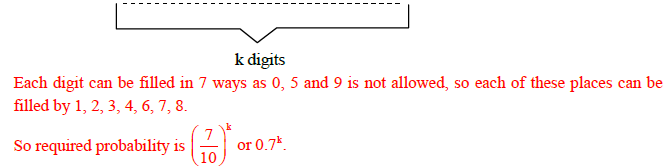
Q10. The probability that a k-digit number does NOT contain the digits 0.5, or 9 is
Answer : Option C
Explaination / Solution: