Mathematics - Online Test
Q1. Number of all 4 digit numbers with distinct digits is
Answer : Option D
Explaination / Solution:
To form a four digit number with distinct digits we can use any four digits from the digits 0,1,2,3,4,5,6,7,8,9 without repetition
Since 0 cannot come as the first digit of a four digit number( then it will be a three digit number) the first place can be filled by any of the 9 digits other than 0.
Now we have 9 more digits left and since repetition is not allowed the second place can by filled by any of these 9 digits
Similarly the third and fourth can be filled by any of the 8 and 7 digits respectively
Hence we get the four places can be filled together by different ways.
Q2. In the following case, determine whether the given planes are parallel orperpendicular, and in case they are neither, find the angles between them. 2x + y + 3z – 2 = 0 and x – 2y + 5 = 0
Answer : Option C
Explaination / Solution:
We have ,
2x + y + 3z – 2 = 0 and x – 2y + 5 = 0. Let
be the angle between the planes , then
As
Therefore , the given planes are perpendicular to each other.
2x + y + 3z – 2 = 0 and x – 2y + 5 = 0. Let
be the angle between the planes , then
As
Therefore , the given planes are perpendicular to each other.
Q3. If z = x + yi ; x ,y R, then locus of the equation

Answer : Option B
Explaination / Solution:
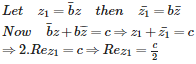
which is a straight line
Q4. Differential equation of the family of circles touching the y-axis at origin is
Answer : Option A
Explaination / Solution:
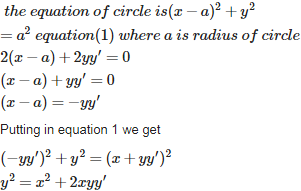
Q5. If in the binomial expansion of the sum of 5th and 6th terms are 0, then is
Answer : Option A
Explaination / Solution:

Q6. Let A = { a ,b ,c } , B = { a, b } , C = { a, b, d } , D = { c , d } and E = { d } . Then which of the following statement is not correct ?
Answer : Option C
Explaination / Solution:
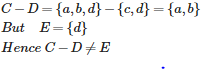
Q7. If x = f(t) and y = g (t), then is qual to
Answer : Option D
Explaination / Solution:
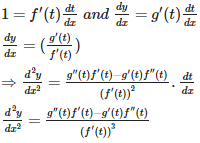
Q8. The corner points of the feasible region determined by the following system of linear inequalities:2x + y ≤ 10, x + 3y ≤ 15, x, y ≥ 0 are (0, 0), (5, 0), (3, 4) and (0, 5). Let Z = px + qy, where p, q > 0. Condition on p and q so that the maximum of Z occurs at both (3, 4) and (0, 5) is
Answer : Option A
Explaination / Solution:
Here Z = px +qy , subject to constraints :
2x + y ≤ 10, x + 3y ≤ 15, x, y ≥ 0
As it is given that Z is maximum at ( 3 ,4 ) and ( 0, 5 ).
Therefore , 3p + 4q = 0p + 5q , which gives 3p = q .
2x + y ≤ 10, x + 3y ≤ 15, x, y ≥ 0
As it is given that Z is maximum at ( 3 ,4 ) and ( 0, 5 ).
Therefore , 3p + 4q = 0p + 5q , which gives 3p = q .
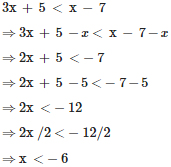
Q9. Solve : 3x + 5 < x − 7, when x is a real number
Answer : Option D
Explaination / Solution:
Q10.
If a, b, c, d , e are in G. P., then equals
Answer : Option D
Explaination / Solution: