Physics - Online Test
Q1. A pebble of mass 0.05 kg is thrown vertically upwards. Give the direction and magnitude of the net force on the pebble, during its downward motion, Ignore air resistance
Answer : Option C
Explaination / Solution:
F = mg = 0.05 x 10 = 0.5 N downwards
Q2. What the universal law of gravitation says is that, if we assume that any two bodies in the universe attract each other with a force proportional to the product of their masses and inversely proportional to the square of the distance between them, then we can explain
Answer : Option D
Explaination / Solution:
Earth and any body pull each other towards themselves , the force applied on both of them remaining the same , but the changes in position of an object is determined by its velocity and acceleration .
Q3. For a parallel plate capacitor and a dielectric of dielectric constant K When a dielectric material is inserted between the plates while_______________ the potential difference between the plates decreases by a factor K
Answer : Option B
Explaination / Solution:
When a dielectric material is introduced in between the plates of a charged capacitor, which is disconnected from the battery, the charge remains constant, while the potential decreases by a factor K. The charge on the plates will increase if the dielectric material is slipped in between the plates of a capacitor which remain connected to the battery. In this case, the potential across the plates of the capacitor remains constant being equal to thebattery voltage.
Q4. Angular momentum is
Answer : Option D
Explaination / Solution:
Axial vector represent rotational effect and are always along the axis of rotation. Direction of angular momentum always along the axis of rotation in accordance with right hand screw rule. Hence angular momentum is an axial vector.
Q5. The molecules on the surface,are-
Answer : Option A
Explaination / Solution:
The surface tension of a liquid results from an imbalance of intermolecular attractive forces, the cohesive forces between molecules:A molecule in the bulk liquid experiences cohesive forces with other molecules in all directions.A molecule at the surface of a liquid experiences only net inward cohesive forces.The unbalanced attraction of molecules at the surface of a liquid tends to pull the molecules back into the bulk liquid leaving the minimum number of molecules on the surface. It required energy to increase the surface area of a liquid because a larger surface area contains more molecules in the unbalanced situation and this may results as the surface being stretched.
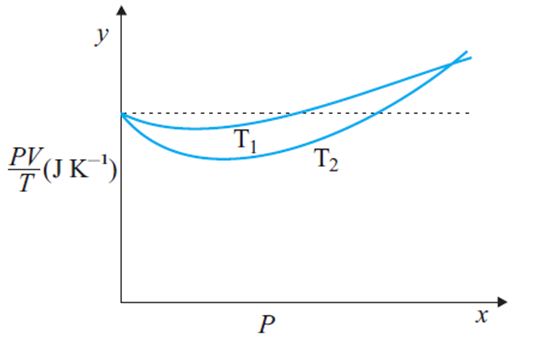
Q6. Figure shows plot of PV/T versus P for 1.00 kg of oxygen gas at two different temperatures. Comparing and
Answer : Option C
Explaination / Solution:
for 1 mole of ideal gas, according to ideal gas equation
hence graph must be with zero slope. So that dotted line show ‘ideal’ gas behavior and curved line shows deviation from ‘ideal’ gas behavior
A real gas behave as ideal gas at high temperature. Temperature T1 is close to dotted line.
so that >
Q7. A plano-convex lens is made of glass of refractive index 1.5. The focal length f of the lens & the radius of curvature R of its curved surface, are related by
Answer : Option A
Explaination / Solution:
No Explaination.
Q8.
The half-life of a radionuclide is
Answer : Option A
Explaination / Solution:
No Explaination.
Q9. A light bulb and an open coil inductor are connected to an ac source . If an iron rod is inserted into the interior of the inductor then
Answer : Option C
Explaination / Solution:
As the iron rod is inserted, the magnetic field inside the coil magnetizes the iron increasing the magnetic field inside it. Hence, the inductance of the coil increases. Consequently, the inductive reactance of the coil increases. As a result, a larger fraction of the applied ac voltage appears across the inductor, leaving less voltage across the bulb. Therefore, the glow of the light bulb decreases.
Q10. if k is the thermal conductivity of the material of the bar of cross section A whose ends are maintained at temperatures and , the rate of flow of heat H is :
Answer : Option D
Explaination / Solution:
rate of flow of heat H depends on
hence
K = thermal conductivity of the material