Physics - Online Test
Q1. A parallel plate capacitor with circular plates of radius 1 m has a capacitance of 1 . At t = 0, it is connected for charging in series with a resistor R = 1 M across a 2V battery. Calculate the magnetic field at a point P, halfway between the centre and the periphery of the plates, after t = s. (The charge on the capacitor at time t is q (t) = CV [1 – exp (–)], where the time constant τ is equal to CR.)
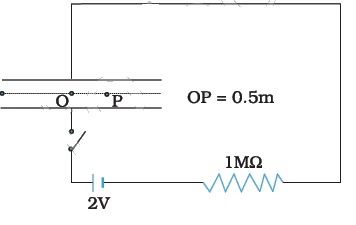
Answer : Option A
Explaination / Solution:
No Explaination.
Q2. A circular coil of radius 10 cm, 500 turns and resistance is placed with its plane perpendicular to the horizontal component of the earth’s magnetic field. It is rotated about its vertical diameter through in 0.25 s. Estimate the magnitudes of the emf and current induced in the coil. Horizontal component of the earth’s magnetic field at the place is
Answer : Option A
Explaination / Solution:
Q3. Photo-electric effect can be explained only by assuming that light
Answer : Option B
Explaination / Solution:
Einstein proposed an explanation of the photoelectric effect using a concept first put forward by Max Planck that light waves consist of tiny bundles or packets of energy known as photons or quanta. When a photon falls on the surface of a metal, the entire photon’s energy is transferred to the electron. A part of this energy is used to remove the electron from the metal atom’s grasp and the rest is given to the ejected electron as kinetic energy. Electrons emitted from underneath the metal surface lose some of the kinetic energy in collisions. But the surface electrons carry all the kinetic energy imparted by the photon and have the maximum kinetic energy.
We can write this mathematically as E = W + Kmax
Q4. Modulation is
Answer : Option B
Explaination / Solution:
Modulation is the process of varying one or more properties of a periodic waveform, called the carrier signal, with a modulating signal that typically contains information to be transmitted. Most radio systems uses frequency modulation (FM) or amplitude modulation (AM) to make the carrier carry the radio broadcast.
Q5. Which of the following statements false?
Answer : Option A
Explaination / Solution:
the average speed of a particle (defined as total path length divided by the time taken to cover the path) is either greater or equal to the magnitude of average velocity of the particle over the same interval of time,
Q6. in an inelastic collision
Answer : Option A
Explaination / Solution:
kinetic energy is transferred to other forms of energy—such as thermal energy, potential energy, and sound—during the collision process. After collision if recovery of kinetic energy is less than % then it is called inelastic collision i.e.. some part of kinetic energy is not recover. So that in an inelastic collision the total kinetic energy after the collision is less than before the collision
Q7.
An electric dipole in an electric field experiences a torque
Answer : Option C
Explaination / Solution:
= pE Sinθ OR =× , the direction of torque or the direction of rotation of dipole is given by right hand palm rule or by Maxwell screw rule.
Q8. Rectangular section is rarely used in beams because
Answer : Option A
Explaination / Solution:
No Explaination.
Q9. Clausius statement of Second Law of Thermodynamics states that
Answer : Option D
Explaination / Solution:
It is impossible for a self acting machine unaided by any external agency to transfer heat from a cold to a hot reservior. In other words,heat by itself cannot pass from a colder to a hotter body.
Q10. Paschen series emission wavelengths are described by
Answer : Option D
Explaination / Solution:
No Explaination.