Physics - Online Test
Q1. A Current carrying wire produces in its neighbourhood
Answer : Option D
Explaination / Solution:
Static charges produce only an electric field. Moving charges produce a magnetic field in addition to their electric fields.
Q2. A dimensionally consistent equation
Answer : Option D
Explaination / Solution:
if an equation fails this consistency test, it is proved wrong, but if it passes, it is not proved right.
Thus, a dimensionally correct equation need not be actually an exact (correct) equation, but a dimensionally wrong (incorrect) or inconsistent equation is definitely wrong.
Q3. An electric bulb rated for 500 watts at 100 volts is used in a circuit having 200 volt supply. The resistance R that must be put in series with the bulb so that the bulb draws 500 watts is
Answer : Option C
Explaination / Solution:
The resistance of the bulb RB = V2/P = 1002/500 = 20\Omega 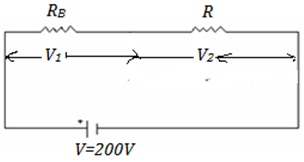
When connected across a 200V supply with a resistor R in series, the power drawn remains the same. If V1 be the p.d across the bulb,V12 = P {RB} = 500 * 20 = 104;
V1 = 100V, . Therefore the p.d across R =200-100=100 V. Therefore R=RB=20Ω
Q4. A body of mass 5 g is executing simple harmonic motion about a point O with amplitude of 10 cm. Its maximum velocity is 100 cm/s. It’s velocity will be 50 cm/s at a distance (in cm) from O
Answer : Option D
Explaination / Solution:
No Explaination.
Q5. n the single slit diffraction the screen is at a large distance compared to slit width and θ is the angle by which light has bent.If the size of slit is a.(given that n is not zero)
The condition for maxima is given by
Answer : Option D
Explaination / Solution:
Experimental observation indicates that the intensity has a central maximum at θ = 0 and other secondary maxima at θ = (n+1/2) λ/a, and has minima (zero intensity) at θ =nλ/a, n = ±1, ±2, ±3, ...
Q6.
The angle of dip at a location in southern India is about . Dip angle in Britain would be
Answer : Option C
Explaination / Solution:
No Explaination.
Q7. A small impurity is added to germanium to get p-type semiconductor. This impurity is a
Answer : Option C
Explaination / Solution:
In a pure (intrinsic) Si or Ge semiconductor, each nucleus uses its four valence electrons to form four covalent bonds with its neighbors. Each ionic core, consisting of the nucleus and non-valent electrons, has a net charge of +4, and is surrounded by 4 valence electrons. Since there are no excess electrons or holes In this case, the number of electrons and holes present at any given time will always be equal.
Now, if one of the atoms in the semiconductor lattice is replaced by an element with three valence electrons, such as a Group 3 element like Boron (B) or Gallium (Ga), the electron-hole balance will be changed. This impurity will only be able to contribute three valence electrons to the lattice, therefore leaving one excess hole. Since holes will "accept" free electrons, a Group 3 impurity is also called an acceptor.
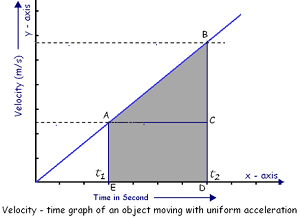
Q8. For motion with uniform acceleration, v-t graph is
Answer : Option A
Explaination / Solution:
When velocity – time graph is plotted for an object moving with uniform acceleration, the slope of the graph is a straight line.
Q9. A pipe of length L with one end closed and other end open (such as air columns) vibrates in the fundamental mode
Answer : Option C
Explaination / Solution:
No Explaination.
Q10. Plane electromagnetic wave of frequency 25 MHz travels in free space along the x-direction. At a particular point in space and time, E = 6.3 j V/m. B at this point is
Answer : Option B
Explaination / Solution:
No Explaination.