Physics - Online Test
Q1. The total mechanical energy of a harmonic oscillator
Answer : Option C
Explaination / Solution:
No Explaination.
Q2. According to superposition principle in relation to displacements produced by a number of waves
Answer : Option D
Explaination / Solution:
No Explaination.
Q3. According to Gauss’s law for magnetism
Answer : Option D
Explaination / Solution:
No Explaination.
Q4. The force of attraction between a hollow spherical shell of uniform density and a point mass situated outside is just as if the entire mass of the shell is
Answer : Option B
Explaination / Solution:
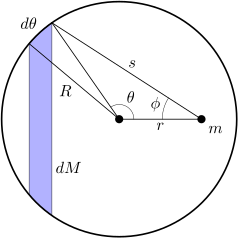
According to Shell's theorem, If a particle of mass m is located outside a spherical shell of mass M at, for instance, point P, the shell attracts the particle as though the mass of the shell were concentrated at its centre. Thus, as far as the gravitational force acting on a particle outside the shell is concerned, a spherical shell acts no differently from the solid spherical distributions of mass.
Q5. In n-type semiconductor the total number of conduction electrons is due to the,
Answer : Option D
Explaination / Solution:
When pentavalent impurity is added to an intrinsic or pure semiconductor (silicon or germanium), then it is said to be an n-type semiconductor. Pentavalent impurities such as phosphorus, arsenic, antimony etc are called donor impurity.
In n-type semiconductor, the population of free electrons is more whereas the population of holes is less. Hence in n-type semiconductor free electrons are called majority carriers and holes are called minority carriers. Therefore, in a n-type semiconductor conduction is mainly because of motion of free electrons.
Q6. Average velocity is defined as
Answer : Option D
Explaination / Solution:
Average velocity is the displacement of an object, divided by the time it took to cover that distance.
Displacement is the straight line distance between the starting point and ending point of an object's motion.
Velocity is referred to as a vector quantity because it has both magnitude and direction.
Q7. Velocity of plane electromagnetic waves in vacuum equals
Answer : Option B
Explaination / Solution:
No Explaination.
Q8. in the same medium transverse and longitudinal waves
Answer : Option A
Explaination / Solution:
As speed of transverse & longitudinal waves depend on different modulus of elasticity (Young's modulus, Bulk modulus, Modulus of Rigidity) of the medium.
So in the same medium transverse and longitudinal waves
travel with different speeds
Q9. If the polarity of induced emf is such that it tends to produce a current which aids the change in magnetic flux that produced it, which conservation law is violated?
Answer : Option C
Explaination / Solution:
In this case we would be obtaining electrical energy continuously without doing any work.
Q10. In various experiments on photo electricity dealing with the stopping potential dependence on frequency of incident radiation , the conclusion was that stopping potential
Answer : Option A
Explaination / Solution:
The stopping potential is defined as the potential necessary to stop any electron even the electron with the most kinetic energy from reaching the other plate. Kinetic energy of electron depends on frequency not on intensity of incident radiation.