Electronic Science - Online Test
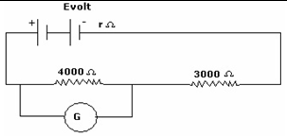
Q1. In the figure, when an ideal voltmeter is connected across 4000 ohm resistance, it reads 30 volts. If the voltmeter is connected across 3000 ohms resistance. It will read
Answer : Option B
Explaination / Solution:
An ideal voltmeter does not draw any current. Therefore the resistances 4000 Ω and 3000 Ω are in series. The current in the circuit
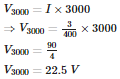
The potential difference across the 3000 Ω resistor
Q2. An 8085 assembly language program is given below.
Line 1: MVI A, B5H
2: MVI B, OEH
3: XRI 69H
4: ADD B
5: ANI 9BH
6: CPI 9FH
7: STA 3010H
8: HLT
After execution of line 7 of the program, the status of the CY and Z flags will be
Answer : Option C
Explaination / Solution:
No Explaination.
Q3. The plates of a parallel plate capacitor are 10 cm apart and have area equal to 2m2. If the charge on each plate is , the electric field at a point
Answer : Option A
Explaination / Solution:
The electric field outside two large plates with opposite charge densities will be zero.
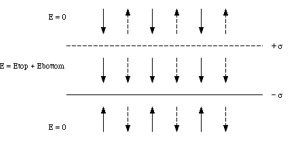
The electric field between the plates of the capacitor
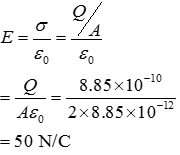
and it is a constant electric field.
The electric field between the plates of the capacitor
and it is a constant electric field.
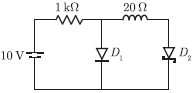
Q4. In the figure, assume that the forward voltage drops of the PN diode D1 and
Schottky diode D2 are 0 7. V and 0 3. V, respectively. If ON denotes conducting
state of the diode and OFF denotes non-conducting state of the diode, then in
the circuit,
Answer : Option D
Explaination / Solution:
Alternatively, we can solve the problem by considering the current through two
diodes. Here, the correct case is only considered. 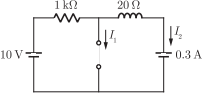
Case : Diode D1 is OFF, D2 is ON. For this case. The equivalent circuit is
From the circuit, we have
I1 = 0
I2 = 10 - 2.3/1.02
= 9.7/1.02
= 9.5 mA
Since, the current I2 is positive, So our assumption is correct.
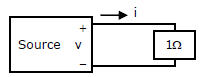
Q5. As shown in the figure, a 1Ω resistance is connected across a source that has a load line v + i =
100. The current through the resistance is
Answer : Option B
Explaination / Solution:
No Explaination.
Q6. A bar magnet of magnetic moment 1.5 J/T lies aligned with the direction of a uniform magnetic field of 0.22 T. What is the amount of work required by an external torque to turn the magnet so as to align its magnetic moment normal to the field direction?
Answer : Option A
Explaination / Solution:
No Explaination.
Q7. A wire of given length is first bent in one loop and the next time it is bent in three loops. If the same current is passed in both the cases, the ratio of the magnetic field induction at their centres will be
Answer : Option C
Explaination / Solution:
If the wire has length L, when it is coiled into a coil of 1 turn of radius r, When it is coiled into a coil of 3 turns of radius r’ .The magnetic field in the first case and in the second case,
Q8. To produce N – type crystal Ge or Si may be doped with a substance that is
Answer : Option B
Explaination / Solution:
If a pentavalent element from the Vth Group such as Antimony (Sb) is added to pure geranium (Ge) or silicone (Si), then four electrons of (Sb) will form covalent bonds with four (Ge) or (Si) atoms. The fifth electron of 'Sb' is free to move which makes (Ge) or (Si) a good conductor. This type of material is called n-type substance.
Q9. According to Ohm's law
Answer : Option C
Explaination / Solution:
Ohm’s law states I is proportional to V.
This holds good at steady temperatures and for the flow of constant current.
Q10. In the Digital-to-Analog converter circuit shown in the figure below, VR = 1V and R = 1kΩ
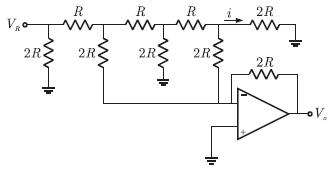
The current i is
Answer : Option B
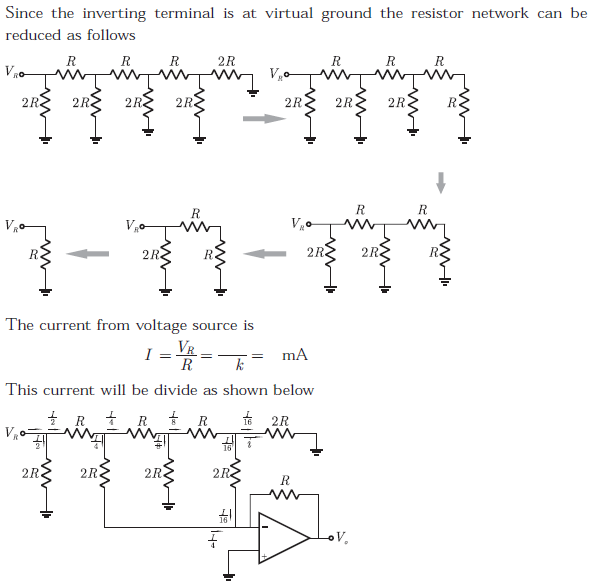
Explaination / Solution: