Electronic Science - Online Test
Q1.
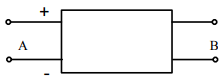
With 10 V dc connected at port A in the linear nonreciprocal two-port network shown below, the following were observed:
(i) 1Ω connected at port B draws a current of 3 A
(ii) 2.5Ω W connected at port B draws a current of 2 A 

For the same network, with 6 V dc connected at port A, 1Ω connected at port B draws 7/3 A. If 8 V dc is connected to port A, the open circuit voltage at port B is 
Answer : Option B
Explaination / Solution:
No Explaination.


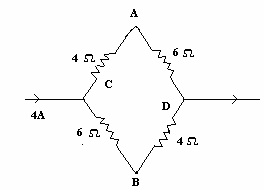
Q2. Find the pd between A and B from the figure

Answer : Option A
Explaination / Solution:

The resistance in the arm CAD  RCAD = 4 + 6 = 10Omega .

The resistance in the arm CBD  RCBD = 6 + 4 = 10Omega

Since the resistances in both the arms are equal, the current splits equally in the arms.ICAD = ICBD = 4/2 = 2A.

The potential difference across A and C.VAC = VA - VC = ICAD * RAC = 2 * 4 = 8V

potential difference across B and C  VBC = VB - VC = ICBD * RBC = 2 * 6 = 12V.The potential difference across A and B  VBA = VB - VA = VBC - VAC = 12 - 8 = 4V.

Point B is at a higher potential when compared to A.


Q3.
if   =magnetic intensity,  =susceptibility, magnetic moment per unit volume  equals

Answer : Option B
Explaination / Solution:
No Explaination.


Q4. The electron and hole concentration in a semiconductor in thermal equilibrium is given by
Answer : Option B
Explaination / Solution:

The number of carriers in the conduction and valence band with no externally applied bias is called the equilibrium carrier concentration.

For majority carriers, the equilibrium carrier concentration is equal to the intrinsic carrier concentration plus the number of free carriers added by doping the semiconductor. Under most conditions, the doping of the semiconductor is several orders of magnitude greater than the intrinsic carrier concentration, such that the number of majority carriers is approximately equal to the doping.

At equilibrium, the product of the majority and minority carrier concentration is a constant, and this is mathematically expressed by the Law of Mass Action.


Where ni is the intrinsic carrier concentration and neand ph are the electron and hole equilibrium carrier concentrations.
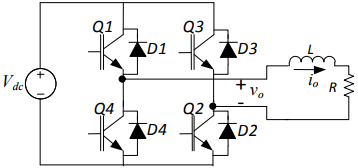

Q5. The Voltage Source Inverter (VSI) shown in the figure below is switched to provide a 50 Hz, square-wave ac output voltage (v0) across an R-L load. Reference polarity of v0 and reference direction of the output current i0 are indicated in the figure. It is given that R = 3 Ω, L = 9.55 mH.
Appropriate transition i.e., Zero Voltage Switching (ZVS) / Zero Current Switching (ZCS) of the IGBTs during turn-on / turn-off is
Answer : Option D
Explaination / Solution:
No Explaination.


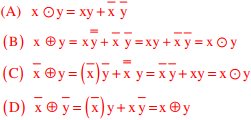
Q6. Which one of the following expressions does NOT represent exclusive NOR of x and y?
Answer : Option D
Explaination / Solution:


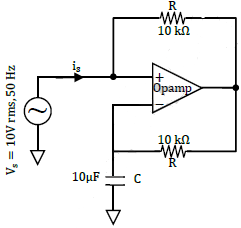
Q7. The following circuit has R = 10kΩ, C = 10μF . The input voltage is a sinusoid at 50Hz with an rms value of 10V. Under ideal conditions, the current is from the source is

Answer : Option D
Explaination / Solution:
No Explaination.


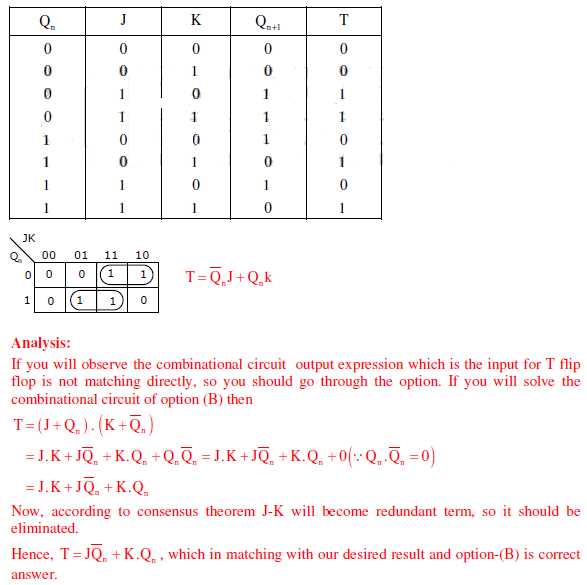
Q8. A JK flip flop can be implemented by T flip-flops. Identify the correct implementation.
Answer : Option B
Explaination / Solution:


Q9. An equipotential surface is a surface
Answer : Option D
Explaination / Solution:

When the potential at all points on the surface is the same; such a surface is called an equipotential surface. The potential difference between any two points on an equipotential surface is zero, while the potential may be positive, negative or even zero.

Q10. The magnetic field at the center of a toroidal coil having n turns,radius r and carrying a current I in air is
Answer : Option B
Explaination / Solution:

A toroid is a solenoid wound on itself. The magnetic field exists only in the region of the hollow circular ring which has the turns of wire wound on it. Using Ampere’s circuital law,