Electronic Science - Online Test
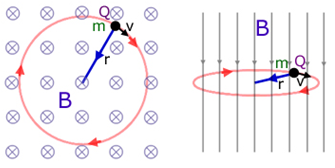
Q1. Consider the motion of a charged particle in a uniform magnetic field directed into the paper.If velocity v of the particle is in the plane of the paper the charged particle will
Answer : Option B
Explaination / Solution:
The charged particle experiences magnetic Lorentz force given by.This force acts in the plane of the paper perpendicular to the velocity vector at all points on the plane. Magnetic Lorentz force acts like a centripetal force, causing the particle to move in a circle.
Q2. In a meter bridge, when galvanometer & cell positions are interchanged
Answer : Option D
Explaination / Solution:
The battery in the circuit(1) shown is connected between A and C, while the galvanometer is connected between B and D. In the bridge balanced condition,
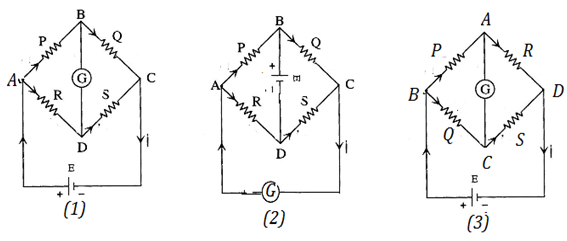
When the battery and the galvanometer are interchanged, the circuit takes the form (2). The circuit (2) can be re drawn as circuit (3). The ratio of the resistances in the bridge balanced condition is which is same as,
When the battery and the galvanometer are interchanged, the circuit takes the form (2). The circuit (2) can be re drawn as circuit (3). The ratio of the resistances in the bridge balanced condition is which is same as,
Q3. In the 3-phase inverter circuit shown, the load is balanced and the gating scheme is 1800 -conduction mode.
All the switching devices are ideal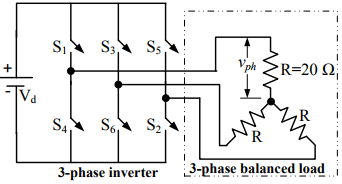
The rms value of load phase voltage is
Answer : Option B
Explaination / Solution:

Q4.
According to the dipole analogy corresponds to
Answer : Option D
Explaination / Solution:
No Explaination.
Q5. Consider the following circuit involving three D-type flip-flops used in a certain type of counter configuration.
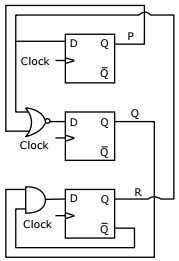
If at some instance prior to the occurrence of the clock edge, P. Q and R have a
value 0, 1 and 0 respectively, what shall be the value of PQR after the clock
edge?
Answer : Option D
Explaination / Solution:
From the Table Shown in the explanation of question 50, if first state is 010 next
State is 011
Q6. In n-type semiconductor the fifth electron
Answer : Option B
Explaination / Solution:
When we add a small quantity of impurity in a semiconductor than the impurity contributes either free electrons or holes to the semiconductor. As a result, the conducting property of semiconductor changes. The process of changing the conductive property of semiconductor by adding impurities is known as doping.
Suppose, in any pure or intrinsic germanium or silicon semiconductor any pentavalent impurity is added. The pentavalent impurities are those which have atoms with five (5) valence electrons. As soon as we add the impurity to the semiconductor, the impurity atoms will replace some of the semiconductor atoms in the crystal structure.
Now four (4) of the five (5) valance electrons of impurity atom will involve in bonding with four neighborhood semiconductor atoms, but the fifth one electron will not find any place to occupy.
This fifth electron of the impurity atom can be made available as free electron or negative charge carrier even if a very small amount of energy is applied.
Q7. 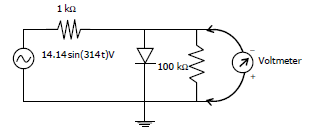
The input impedance of the permanent magnet moving coil (PMMC) voltmeter is infinite. Assuming that the diode shown in the figure below is ideal, the reading of the voltmeter in Volts is
Answer : Option A
Explaination / Solution:
No Explaination.
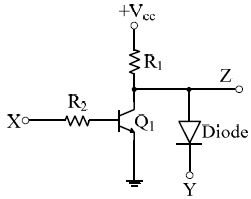
Q8. In the circuit shown below, Q1 has negligible collector-to-emitter saturation
voltage and the diode drops negligible voltage across it under forward bias. If Vcc is +5V, X and Y are digital signals with 0V as logic 0 and Voc as logic 1, then the
Boolean expression for Z is
Answer : Option B
Explaination / Solution:
No Explaination.
Q9. Electric potential at a distance r from a point charges q is
Answer : Option D
Explaination / Solution:
Electric potential at a point V is the work done in bringing unit positive charge from infinity to the point in an electric field.
Q10. An RLC circuit with relevant data is given below.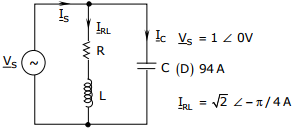
The current Ic in the figure above is
Answer : Option D
Explaination / Solution: