Electronics Engineering - Online Test
Q1. 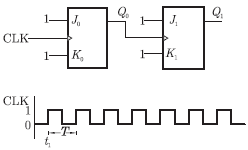
For each of the positive edge-triggered J - K flip flop used in the following figure, the propagation delay is Δt .
Which of the following wave forms correctly represents the output at Q1?
Answer : Option B
Explaination / Solution:



Since the input to both JK flip-flop is 11, the output will change every time with clock pulse. The input to clock is
The output Q0 of first FF occurs after time ΔT and it is as shown below
The output Q1 of second FF occurs after time ΔT when it gets input (i.e. after ΔT from t1) and it is as shown below
Q2. The current through the 2 kΩ resistance in the circuit shown is

Answer : Option A
Explaination / Solution:
It is a balanced Wheatstone bridge.
Q3. If the closed-loop transfer function of a control system is given as 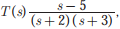 then It is
then It is
Answer : Option D
Explaination / Solution:
In a minimum phase system, all the poles as well as zeros are on the left half of the s −plane. In given system as there is right half zero (s = 5), the system is a non-minimum phase system.
Q4. In binary frequency shift keying (FSK), the given signal waveform are
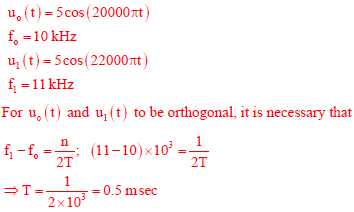
u0 (t) = 5cos (20000 πt); 0 ≤ t ≤ T, and
u1 (t) = 5cos (22000 πt); 0 ≤ t ≤ T,
Where T is the bit-duration interval and t is in seconds. Both u0 (t) and u1 (t) are zero outside the interval 0 ≤ t ≤ T. With a matched filter (correlator) based receiver, the smallest positive value of T (in milliseconds) required to have u0 (t) and u1 (t) uncorrelated is
Answer : Option B
Explaination / Solution:
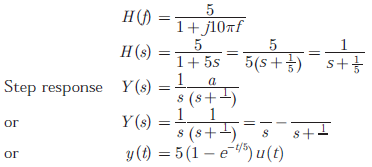
Q5. The frequency response of a linear, time-invariant system is given by  The step response of the system is
The step response of the system is
Answer : Option B
Explaination / Solution:
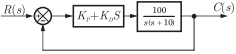
Q6. A control system with PD controller is shown in the figure. If the velocity error
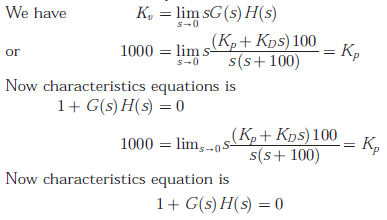
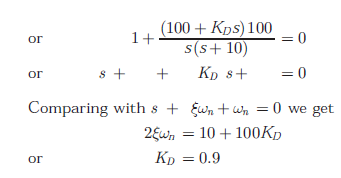
constant KV = 000 and the damping ratio ζ = 0.5, then the value of KP and KD are
Answer : Option B
Explaination / Solution:
Q7. 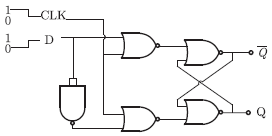
For the circuit shown in the figure, D has a transition from 0 to 1 after CLK changes from 1 to 0. Assume gate delays to be negligible. Which of the following statements is true
Answer : Option A
Explaination / Solution:
No Explaination.
Q8. In a forward biased pn junction diode, the sequence of events that best describes the mechanism of current flow is
Answer : Option A
Explaination / Solution:
The potential barrier of the pn junction is lowered when a forward bias voltage is applied, allowing electrons and holes to flow across the space charge region (Injection) when holes flow from the p region across the space charge region into the n region, they become excess minority carrier holes and are subject to diffuse, drift and recombination processes.
Hence correct option is (A)
Q9. The equivalent capacitance of the input loop of the circuit shown is
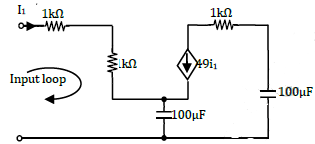
Answer : Option A
Explaination / Solution:
No Explaination.
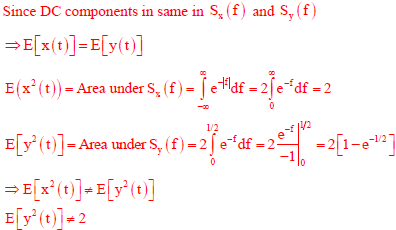
Q10. Let X(t) be a wide sense stationary random process with the power spectral density SX(f) as shown in Figure (a), where f is in Hertz (Hz). The random process X(t) is input to an ideal low pass filter with frequency response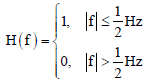
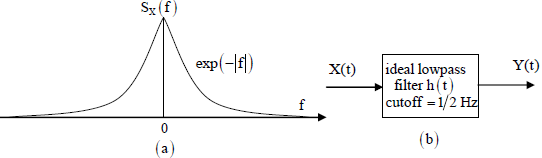
As shown in Figure (b). The output of the lowpass filter is Y(t ).
Let E be the expectation operator and consider the following statements.
I. E( X(t)) = E(Y(t))
II. E( X2(t)) = E(Y2(t))
III. E(Y2(t)) = 2
Select the correct option:
Answer : Option A
Explaination / Solution: