Electrical Engineering - Online Test
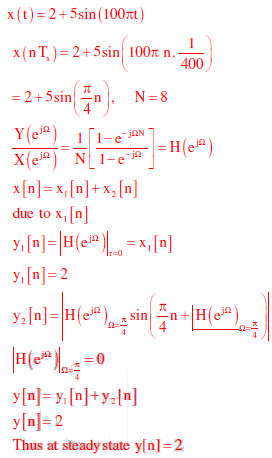
Q1. An input signal x(t) = 2 + 5sin (100πt) is sampled with a sampling frequency of 400 Hz and
applied to the system whose transfer function is represented by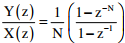
where, N represents the number of samples per cycle. The output y(n) of the system under steady state is
Answer : Option C
Explaination / Solution:
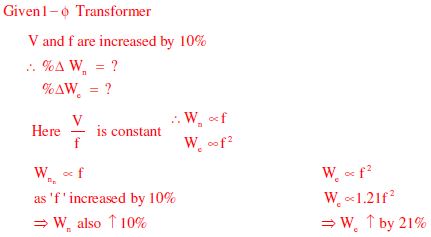
Q2. For a single phase, two winding transformer, the supply frequency and voltage are both increased by 10%. The percentage changes in the hysteresis loss and eddy current loss, respectively, are
Answer : Option A
Explaination / Solution:
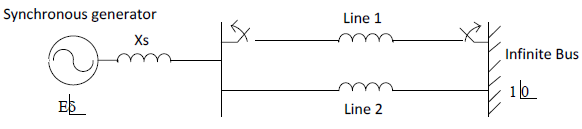
Q3. The synchronous generator shown in the figure is supplying active power to an infinite
bus via two short, lossless transmission lines, and is initially in steady state. The
mechanical power input to the generator and the voltage magnitude E are constant. If one
line is tripped at time t1 by opening the circuit breakers at the two ends (although there is
no fault), then it is seen that the generator undergoes a stable transient. Which one of the
following waveforms of the rotor angle δ shows the transient correctly?
Answer : Option A
Explaination / Solution:

Q4. For linear time invariant systems, that are Bounded Input Bounded stable, which one of the following statement is TRUE?
Answer : Option B
Explaination / Solution:
No Explaination.
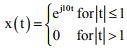
Q5. Consider a signal defined by
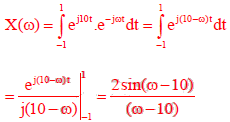
Its Fourier Transform is
Answer : Option A
Explaination / Solution:
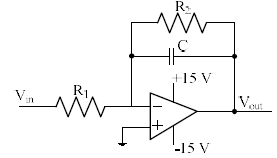
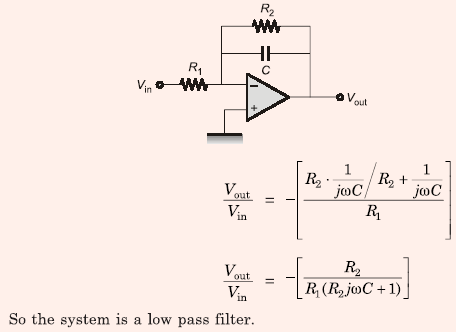
Q6. The circuit shown below is an example of a
Answer : Option A
Explaination / Solution:
Q7. A signal flow graph of a system is given below
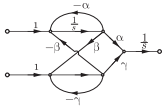
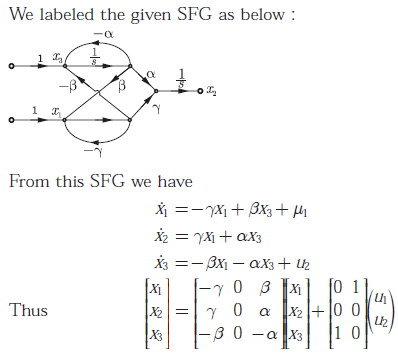
The set of equalities that corresponds to this signal flow graph is
Answer : Option C
Explaination / Solution:
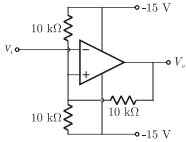
Q8. Consider the Schmidt trigger circuit shown below
A triangular wave which goes from -12 to 12 V is applied to the inverting input
of OPMAP. Assume that the output of the OPAMP swings from +15 V to -15 V.
The voltage at the non-inverting input switches between
Answer : Option C
Explaination / Solution:
Let the voltage at non inverting terminal be V1, then after applying KCL at non
inverting terminal side we have
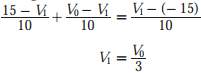
If V0 swings from -15 to +15 V then V1 swings between -5 V to +5 V.
Q9. Consider the following assertions.
S1 : For Zener effect to occur, a very abrupt junction is required.
S2 : For quantum tunneling to occur, a very narrow energy barrier is required.
Which of the following is correct ?
Answer : Option A
Explaination / Solution:
No Explaination.
Q10. 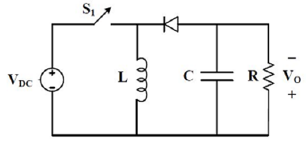
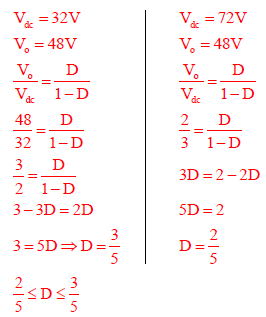
The input voltage VDC of the buck-boost converter
shown below varies from 32 V to 72 V. Assume that
all components are ideal, inductor current is
continuous, and output voltage is ripple free. The
range of duty ratio D of the converter for which the
magnitude of the steady state output voltage remains
constant at 48 V is
Answer : Option A
Explaination / Solution: