Electronics Engineering - Online Test
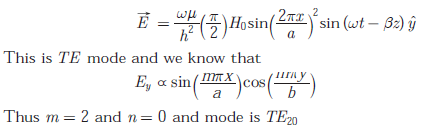
Q1. The field in a rectangular waveguide of inner dimension a × b is given by
field in a rectangular waveguide of inner dimension a × b is given by Where H0 is a constant, and a and b are the dimensions along the x − axis and
the y − axis respectively. The mode of propagation in the waveguide is
Answer : Option A
Explaination / Solution:
Q2. An RLC circuit with relevant data is given below.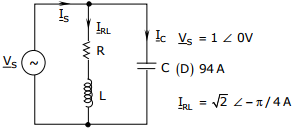
The current Ic in the figure above is
Answer : Option D
Explaination / Solution:

Q3. Which of the following is NOT associated with a p - n junction ?
Answer : Option D
Explaination / Solution:
Channel length modulation is not associated with a p - n junction. It is being associated with MOSFET in which effective channel length decreases, producing the phenomenon called channel length modulation.
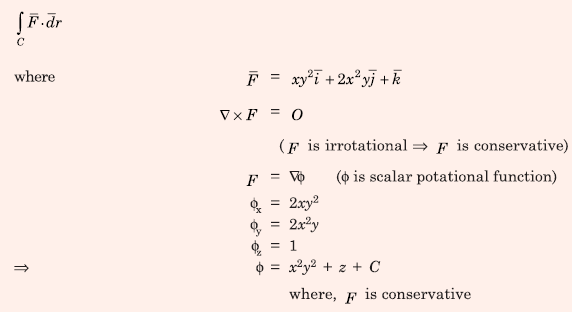
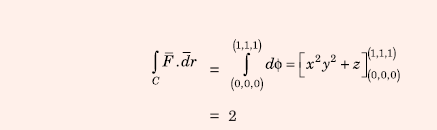
Q4. The value of the line integral
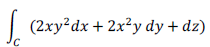
along a path joining the origin (0, 0, 0) and the point (1, 1, 1) is
Answer : Option B
Explaination / Solution:
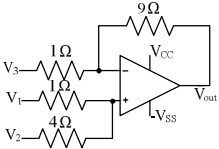
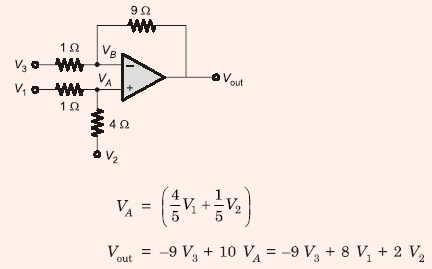
Q5. For the circuit shown below, taking the opamp as ideal, the output voltage Vout in terms of the input
voltages V1 , V2 and V3 is
Answer : Option D
Explaination / Solution:
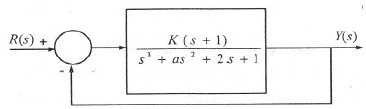
Q6. T he feedback system shown below oscillates at 2 rad/s when
Answer : Option A
Explaination / Solution:
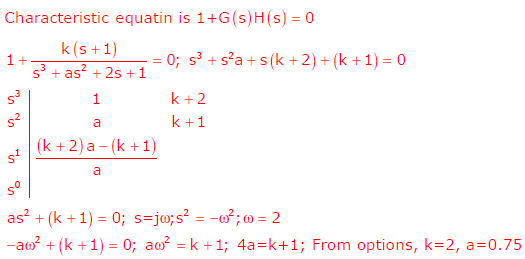
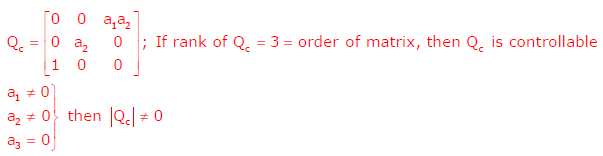
Q7. The state variable description of an LTI system is given by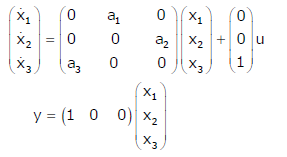
where y is the output and u is the input. The system is controllable for
Answer : Option D
Explaination / Solution:

Q8. In the 3-phase inverter circuit shown, the load is balanced and the gating scheme is 1800 -conduction mode. All the switching devices are ideal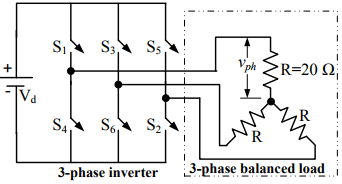
If the dc bus voltage Vd = 300 V, the power consumed by 3-phase load is
Answer : Option D
Explaination / Solution:

Q9. The decimal value 0.5 in IEEE single precision floating point representation has
Answer : Option B
Explaination / Solution:
(0.5)10 = (1.0)2 × 2-1
So, exponent = -1 and fraction is 000 - - - 000
Q10. 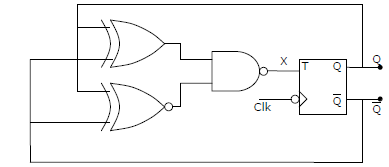
The clock frequency applied to the digital circuit shown in the figure below is 1kHz. If the initial state of the output of the flip-flop is 0, then the frequency of the output waveform Q in kHz is
Answer : Option B
Explaination / Solution:
No Explaination.