Computer Science Engineering - Online Test
Q1. A software requirements specification (SRS) document should avoid discussing which one of
the following?
Answer : Option D
Explaination / Solution:
SRS is a description of a software system to be developed, laying out functional & nonfunctional
requirements and may include a set of use cases that describe interactions the user
will have with the software.
Q2. Which one of the following protocols is NOT used to resolve one form of address to another
one?
Answer : Option C
Explaination / Solution:
Except DHCP, remaining all the protocols are used to resolve one form of address to another
one.
Q3. Consider the following table:
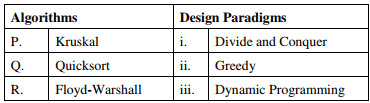
Match the algorithms to the design paradigms they are based on.
Answer : Option C
Explaination / Solution:
Kruskal’s algorithm follows greedy approach in order to find MST of a connected graph.
Quick sort follows divide and conquer strategy. Floyd Warshal algorithm is used to find the
shortest path between every pair of vertices and it follows dynamic programming strategy.
Q4. Consider a combination of T and D flip-flops connected as shown below. The output of the D flip-flops is connected to the input of the T flip-flop and the output of the T Flip-flop connected to the input of the D Flip-flop. 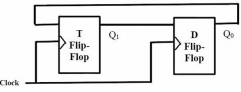
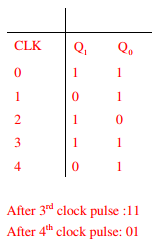
Initially, both Q0 and Q1 are set to 1 ( before the 1st clock cycle). The outputs
Answer : Option B
Explaination / Solution:
Q5. The worst case running time to search for an element in a balanced binary search tree with
n2n elements is
Answer : Option C
Explaination / Solution:
The worst case search time in a balanced BST on ‘x’ nodes is logx. So, if x = n2n , then log(n2n) = logn + log(2n) = logn + n = θ(n)
Q6. Consider the languages L1 = Φ and L2 = {a} . Which one of the following represents L1 L2* UL1* ?
Answer : Option A
Explaination / Solution:
No Explaination.
Q7. The following code segment is executed on a processor which allows only register operands in its instructions. Each instruction can have almost two source operands and one destination operand.
Assume that all variables are dead after this code segment
c = a + b;
d = c * a;
e = c + a;
x = c *c;
if (x > a) {
y = a * a;
}
else {
d = d * d;
e = e * e;
}
What is the minimum number of registers needed in the instruction set architecture of the
processor to compile this code segment without any spill to memory? Do not apply any
optimization other than optimizing register allocation
Answer : Option B
Explaination / Solution:
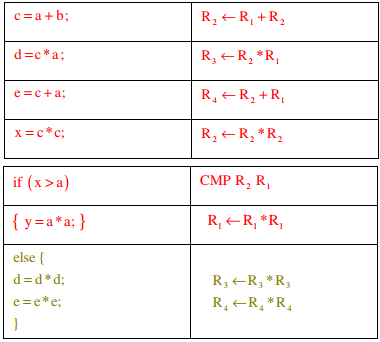
In the above code minimum number of registers needed are = 4
Q8. Which of the following statements are CORRECT?
1) Static allocation of all data areas by a compiler makes it impossible to implement
recursion.
2) Automatic garbage collection is essential to implement recursion.
3) Dynamic allocation of activation records is essential to implement recursion.
4) Both heap and stack are essential to implement recursion.
Answer : Option D
Explaination / Solution:
To implement recursion, activation record should be implemented by providing dynamic
memory allocation. This dynamic allocation is done from runtime stack. Heap is essential to
allocate memory for data structures at run-time, not for recursion.
So statement 1 and 3 are correction.
Q9. What is the optimized version of the relation algebra expression 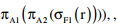 where
A1, A2 are sets of attributes in with A1 ⊂ A2 and F1, F2 are Boolean expressions based on
where
A1, A2 are sets of attributes in with A1 ⊂ A2 and F1, F2 are Boolean expressions based on
where
A1, A2 are sets of attributes in with A1 ⊂ A2 and F1, F2 are Boolean expressions based on
Answer : Option A
Explaination / Solution:
No Explaination.
Q10. Consider a processor with byte-addressable memory. Assume that all registers, including
Program Counter (PC) and Program Status Word (PSW), are of size 2 bytes. A stack in the
main memory is implemented from memory location (0100)16 and it grows upward. The
stack pointer (SP) points to the top element of the stack. The current value of SP is (016E)16.
The CALL instruction is of two words, the first word is the op-code and the second word is
the starting address of the subroutine. (oneword = 2bytes). The CALL instruction is
implemented as follows:
Store the current Vale of PC in the Stack
Store the value of PSW register in the stack
Load the starting address of the subroutine in PC
The content of PC just before the fetch of a CALL instruction is (5FA0)16. After execution of
the CALL instruction, the value of the stack pointer is
Answer : Option D
Explaination / Solution:
No Explaination.