Physics - Online Test
Q1. With reference to the figure the value of can be calculated by

Answer : Option C
Explaination / Solution:
No Explaination.
Q2. As a ball rises the vertical component of its velocity
Answer : Option C
Explaination / Solution:
if a ball is thrown upward at an angle? The ball has a vertical and a horizontal component of velocity. The force of gravity is acting on it and its acceleration is in the downward direction. The vertical component of velocity is therefore changing. As the motion and acceleration is in opposite direction so vertical component of velocity decrease.
Q3. A point charge of 2.0 μC is at the centre of a cubic Gaussian surface 9.0 cm on edge. What is the net electric flux through the surface?
Answer : Option A
Explaination / Solution:
ϕ=q∈0=2×10−68.85×10−12=2.26×10⁵Nm2/C
Q4. A lead cube measures 6.00 cm on each side. The bottom face is held in place by very strong glue to a flat horizontal surface, while a horizontal force F is applied to the upper face parallel to one of the edges. How large must F be to cause the cube to deform by 0.250 mm? (Shear modulus of lead = 0.6 Pa)
Answer : Option B
Explaination / Solution:
No Explaination.
Q5.
A 3.00-g copper penny at 25.0C drops from a height of 50.0 m to the ground. (a) If 60.0percent of the change in potential energy goes into increasing the internal energy, what is its final temperature? Specific heat of Cu
Answer : Option A
Explaination / Solution:
Heat used in increasing temp
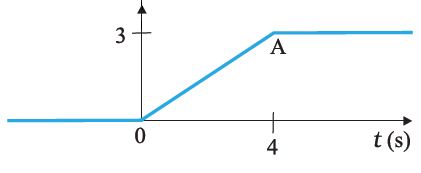
Q6. Figure shows the position-time graph of a particle of mass 4 kg. What is the force on the particle for ?
Answer : Option C
Explaination / Solution:
When t < 0. As this part is horizontal, thus it can be concluded that distance covered by the particle is zero and hence force on the particle is zero.
When 0 < t < 4 s. As OA has a constant slope, hence in this interval, particle moves with constant velocity (acceleration = 0). Hence force on the particle is zero.
W'hen t > 4s. As this portion shows that particle always remains at a distance of 3 m from the origin i.e., the particle is at rest. Hence force on the particle is zero.
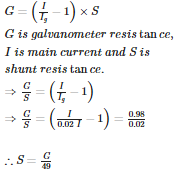
Q7. If 2% of the main current is to be passed through the galvanometer of resistance G, the resistance of shunt required is
Answer : Option C
Explaination / Solution:
The current Ig through a galvanometer of resistance G is 0.02 I where I is the main current.
The shunt resistance S is calculated as follows.
Q8. The launching mechanism of a toy gun consists of a spring of unknown spring constant. When the spring is compressed 0.120 m, the gun, when fired vertically, is able to launch a 35.0-g projectile to a maximum height of 20.0 m above the position of the projectile before firing. Neglecting all resistive forces, determine the spring constant.
Answer : Option A
Explaination / Solution:
Potential energy of spring converted in to potential energy
Q9. Probability of backward scattering (i.e., scattering of α -particles at angles greater than ) predicted by Thomson’s model is
Answer : Option C
Explaination / Solution:
No Explaination.
Q10. The electric field between the plates of a fully charged capacitor is E. If a material of dielectric constant k is introduced between the plates, the electric field at a point between the plates
Answer : Option C
Explaination / Solution:
The capacitance C of a capacitor becomes KC when a dielectric is introduced. ;A fully charged capacitor is the capacitor which is charged and then disconnected from the battery. The charge therefore remains constant, The potential reduces to.The electric field therefore becomes