Physics - Online Test
A jet plane is travelling towards west at a speed of 1800 km/h. If the Earth’s magnetic field at the location has a magnitude of and the dip angle is , voltage difference developed between the ends of the wing having a span of 25 m is approximately
V = Vertical component of magnetic field
Speed of the cyclist, v = 27 km/h = 7.5 m/s
Radius of the circular turn, r = 80 m
Centripetal acceleration is given as:
ac = 0.7 ms-2
The situation is shown in the given figure:
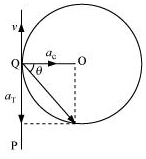
Suppose the cyclist begins cycling from point P and moves toward point Q. At point Q, he applies the breaks and decelerates the speed of the bicycle by 0.5 m/s2.
This acceleration is along the tangent at Q and opposite to the direction of motion of the cyclist.
Since the angle between ac and aT is 900, the resultant acceleration a is given by:
a =
= = 0.86 ms-2
tan θ =
where θ is the angle of the resultant with the direction of velocity.
tan θ = = 1.4
θ = tan-1(1.4) = 54.56° with the direction of velocity

A 1.0-mol sample of an ideal gas is kept at 0.0C during an expansion from 3.0 L to 10.0 L. How much work is done by the gas during the expansion?
In isothermal process
A man of mass 70 kg stands on a weighing scale in a lift which is moving upwards with a uniform acceleration of 5 m what would be the reading on the scale?
When the lift moves upward with acceleration = 5 ms-2 the net force acting upward
R = 1050 N
(We experience weight due to reaction)
therefore Apparent weight =