Physics - Online Test
Q1. Using the Bohr’s model Calculate the orbital period of the electron in a hydrogen atom in the n = 1, 2, and 3 levels.
Answer : Option A
Explaination / Solution:
No Explaination.
Q2. A man of mass 70 kg stands on a weighing scale in a lift which is moving upwards with a uniform speed of 10 m , what would be the reading on the scale?
Answer : Option D
Explaination / Solution:
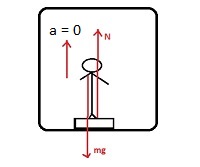
Mass of the man, m = 70 kg
Acceleration, a = 0
UsingNewton’s second law of motion,
wecan write the equation of motion as:
R – mg = ma
Where, ma is the net force acting on the man.
As the lift is moving at a uniform speed, acceleration a = 0
∴ R = mg = 70 × 10 = 700 N
∴ Reading on the weighing scale = 700 / g = 700 / 10 = 70 kg
Q3. A body of mass 0.5 kg travels in a straight line with velocity v =a where a = 5 . What is the work done by the net force during its displacement from x = 0 to x = 2 m?
Answer : Option B
Explaination / Solution:
Mass of the body, m= 0.5 kg
Velocity of the body
Initial velocity at x = 0 is u = 0
Final velocity at x = 2 m is
work done = Change in kinetic energy
Q4. Which of these is not a fundamental force?
Answer : Option B
Explaination / Solution:
There are four conventionally accepted fundamental interactions—gravitational, electromagnetic, strong, and weak. Each one is described mathematically as a field.
Q5. The action of the dielectric to increase the capacitance is due to
Answer : Option D
Explaination / Solution:
When a dielectric is placed between the plates of a capacitor, electric polarization results in a reverse electric field inside the dielectric.
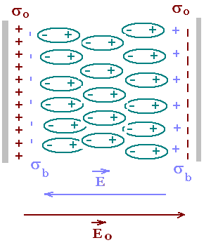
The net electric field reduces and therefore the potential reduces. Sincethe capacitance increases because the potential reduces.The charges in a dielectric are incapable of moving since all dielectrics are essentially insulators. The molecules of the dielectric acquire an induced dipole moment in the direction of the applied field, due to rearrangement of their electron clouds.The charges in the dielectric and those on the capacitor plates are not equal in magnitude. They are not neutralized. The dipoles in the dielectric are oriented perpendicular to the plates as the electric field is perpendicular to the plates.
The net electric field reduces and therefore the potential reduces. Sincethe capacitance increases because the potential reduces.The charges in a dielectric are incapable of moving since all dielectrics are essentially insulators. The molecules of the dielectric acquire an induced dipole moment in the direction of the applied field, due to rearrangement of their electron clouds.The charges in the dielectric and those on the capacitor plates are not equal in magnitude. They are not neutralized. The dipoles in the dielectric are oriented perpendicular to the plates as the electric field is perpendicular to the plates.
Q6. A body of mass 2.0 kg and radius of gyration 0.5 m is rotating about an axis. If its angular speed is 2.0 rad/s, the angular momentum of the body (in kg - /s) is
Answer : Option D
Explaination / Solution:
angular momentum
Q7. A drop of oil is placed on the surface of water. Which of the following statements is correct?
Answer : Option A
Explaination / Solution:
when any liquid is poured onto another liquid there are different phenomena that can take place depending on the properties of liquids:In case of crude oil and water -
The two liquids are non-miscible and the first is lighter than the second. The first liquid then spreads on the surface of the second liquid forming a thin layer. The thickness of this layer depends on the properties of the two liquids. This is the case for most hydrocarbons, including both refined products and crude oil of API gravity greater than 10.
Q8. In a 30.0-s interval, 500 hailstones strike a glass window with an area of 0.600 at an angle of 45.0 to the window surface. Each hailstone has a mass of 5.00 g and a speed of 8.00 m/s. If the collisions are elastic, what is the pressure on the window?
Answer : Option A
Explaination / Solution:
P=FAF=500×ΔpΔt=500×2mvcos45∘Δt=500×2×5×10−3×8×130×1.41A=0.6m2P=500×2×5×10−3×8×130×1.41×0.6=1.57Pa
Q9. In a Young’s double-slit experiment, if the slits are of unequal width
Answer : Option C
Explaination / Solution:
No Explaination.
Q10. If M is the atomic mass, A is the mass number then (M – A)/A is called
Answer : Option B
Explaination / Solution:
No Explaination.