Physics - Online Test
Initial velocity u = 20.0 m/s
At maximum height it ll stop
So final velocity v = 0 m/s
Acceleration due to gravity g = 9.8 m/s2
Time taken to reach maximum height = t
We know
v = u + at
=>
[g is taken negative because it is in opposite direction of motion.]
The positions of the observer and the aircraft are shown in the given figure.
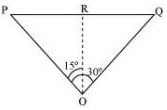
Height of the aircraft from ground, OR = 3400 m
Angle subtended between the positions, ∠POQ = 30°
Time = 10 s
In ΔPRO:
tan 15° =
PR = OR tan 15°
=
ΔPRO is similar to ΔRQO.
∴PR = RQ
PQ = PR + RQ
= 2PR = 2 × 3400 tan 15°
= 6800 × 0.268 = 1822.4 m
∴ Speed of the aircraft =
= 182.24 m/s m/s
A 1.0-mol sample of an ideal gas is kept at 0.0C during an expansion from 3.0 L to 10.0 L. How much energy transfer by heat occurs with the surroundings in this process?
in isothermal process
hence