Electronics Engineering - Online Test
Q1. A function 1 – x2 + x3 is defined in the closed interval [-1, 1]. The value of x , in the open interval (-1, 1) for which the mean value theorem is satisfied, is
Answer : Option B
Explaination / Solution:
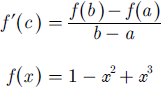
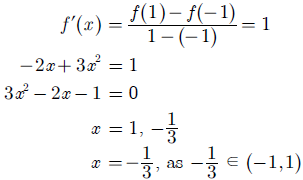
Lagrange’s mean value theorem states that if a function f(x) is continuous in close interval [a, b] and differentiable in open interval (a + b), then for point c in the interval, we may define
Since, polynomial function is always continuous and differentiable, so
Q2. The output F in the digital logic circuit shown in the figure is

Answer : Option A
Explaination / Solution:
In the logic circuit, the two inputs to the output AND gate are


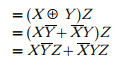
So, we have the output
Q3.
Two systems with impulse responses h1(t) and h2(t) are connected in cascade. Then the overall impulse response of the cascaded system is given by
Answer : Option C
Explaination / Solution:
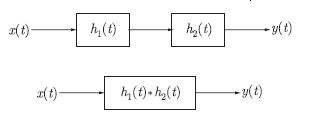
If the two systems with impulse responseh1(t) and h2(t) are connected in cascaded configuration as shown in figure, then the overall response of the system is the convolution of the individual impulse responses.
Q4. A four-phase and an eight-phase signal constellation are shown in the figure
below.
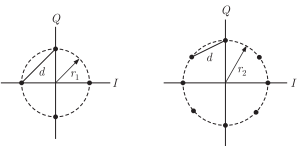
Assuming high SNR and that all signals are equally probable, the additional
average transmitted signal energy required by the 8-PSK signal to achieve the
same error probability as the 4-PSK signal is
Answer : Option D
Explaination / Solution:
Here Pe for 4 PSK and 8 PSK is same because Pe depends on d . Since Pe is same,
d is same for 4 PSK and 8 PSK.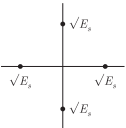
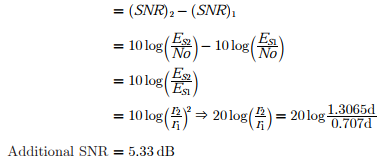
Additional Power SNR
Q5. Consider the following statements for continuous-time linear time invariant (LTI) systems.
I. There is no bounded input bounded output (BIBO) stable system with a pole in the right half of the complex plane.
II. There is non causal and BIBO stable system with a pole in the right half of the complex plane.
Which one among the following is correct?
Answer : Option D
Explaination / Solution:
If a system is non-causal then a pole on right half of the s-plane can give BIBO stable system. But for a causal system to be BIBO all poles must lie on left half of the complex plane.
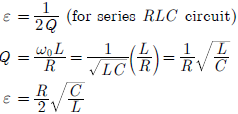
Q6. The damping ratio of a series RLC circuit can be expressed as
Answer : Option C
Explaination / Solution:
Damping ratio is given by
Q7. Consider the Boolean function,  . Which one of the following is the complete set of essential prime implicants ?
. Which one of the following is the complete set of essential prime implicants ?
Answer : Option D
Explaination / Solution:
k -map for the Boolean function can be given as


Therefore, the simplified So P from for the Boolean function is
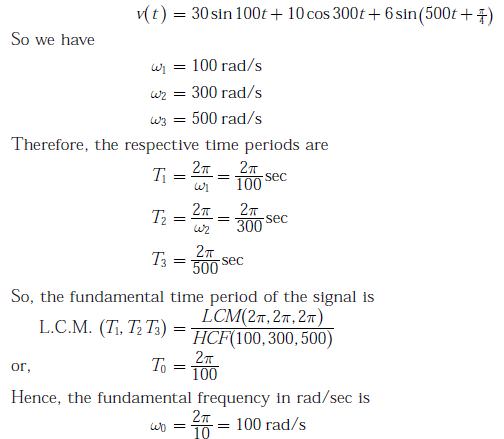
Q8. For a periodic signal  the fundamental frequency in rad/s
the fundamental frequency in rad/s
Answer : Option A
Explaination / Solution:
Given, the signal
Q9. The block diagram of a frequency synthesizer consisting of a Phase Locked Loop (PLL) and a
divide-by-𝑁 counter (comprising ÷2, ÷4, ÷8, ÷16 outputs) is sketched below. The synthesizer is
excited with a 5 kHz signal (Input 1). The free-running frequency of the PLL is set to20 kHz.
Assume that the commutator switch makes contacts repeatedly in the order 1-2-3-4.
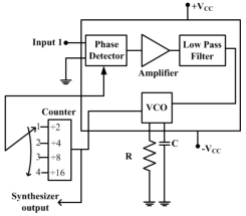
The corresponding frequencies synthesized are:
Answer : Option A
Explaination / Solution:
No Explaination.
Q10. A linear time invariant (LTI) system with the transfer function
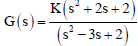
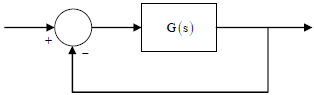
is connected in unity feedback configuration as shown in the figure.
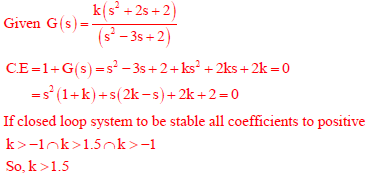
For the closed loop system shown, the root locus for 0 < K < ∞ intersects the imaginary axis for K = 1.5. The closed loop system is stable for
Answer : Option A
Explaination / Solution: