Electrical Engineering - Online Test
Q1. The solution of the differential equation 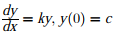 is
is
is
Answer : Option C
Explaination / Solution:
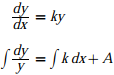
lny = kx + A
Since y(0) = c thus lnc = A
lny = kx + lnc
Iny = Inekx + Inc
y = cekx
Q2. The differential equation 100 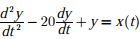 describes a system with an
in
put x (t) and an output y(t). The system, which is initially relaxed, is excited by
a unit step input. The output y(t) can be represented by the waveform
describes a system with an
in
put x (t) and an output y(t). The system, which is initially relaxed, is excited by
a unit step input. The output y(t) can be represented by the waveform
describes a system with an
in
put x (t) and an output y(t). The system, which is initially relaxed, is excited by
a unit step input. The output y(t) can be represented by the waveform
Answer : Option A
Explaination / Solution:
100 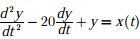
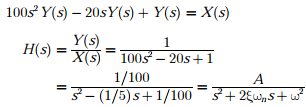

Applying Laplace transform we get
Roots are s = 1/10, 1/10 which lie on Right side of s plane thus unstable
Q3. The trigonometric Fourier series of an even function does not have the
Answer : Option C
Explaination / Solution:
For an even function Fourier series contains dc term and cosine term (even and odd harmonics).
Q4. The value of the integral  where c is the circle |z| = 1 is given
by
where c is the circle |z| = 1 is given
by
where c is the circle |z| = 1 is given
by
Answer : Option A
Explaination / Solution:
C R Integrals is  where C is circle |z| = 1
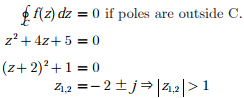
where C is circle |z| = 1So poles are outside the unit circle.
Q5. Let 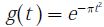 , and h(t) is a filter matched to g(t). if g(t) is applied as input to h(t) then the Fourier transform of the output is
, and h(t) is a filter matched to g(t). if g(t) is applied as input to h(t) then the Fourier transform of the output is
Answer : Option D
Explaination / Solution:
The matched filter is characterized by a frequency response that is given as
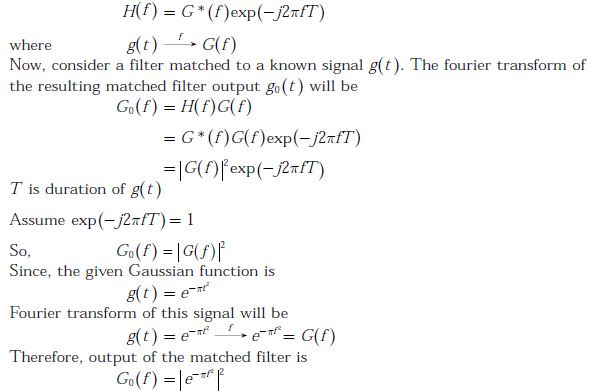
Q6.
Let U and V be two independent zero mean Gaussain random variables of variances 1/4 and 1/9 respectively. The probability

Answer : Option B
Explaination / Solution:
Given, random variables U and V with mean zero and variances 1/4 and 1/9
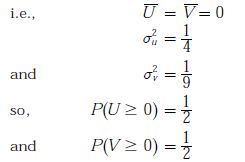
The distribution is shown in the figure below

We can express the distribution in standard form by assuming

The distribution is shown in the figure below
We can express the distribution in standard form by assuming
Q7. If  then the initial and final values of f(t) are
respectively
then the initial and final values of f(t) are
respectively
then the initial and final values of f(t) are
respectively
Answer : Option B
Explaination / Solution:
No Explaination.
Q8. A numerical solution of the equation  can be obtained using
Newton- Raphson method. If the starting value is x = 2 for the iteration, the
value of x that is to be used in the next step is
can be obtained using
Newton- Raphson method. If the starting value is x = 2 for the iteration, the
value of x that is to be used in the next step is
can be obtained using
Newton- Raphson method. If the starting value is x = 2 for the iteration, the
value of x that is to be used in the next step is
Answer : Option C
Explaination / Solution:
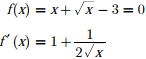



Substituting x0 = 2 we get
Newton Raphson Method
Substituting all values we have
Q9. The system of equations
x + Y + z = 6
x + 4y + 6y = 20
x + 4y + λz = μ
has NO solution for values of λ and μ given by
Answer : Option B
Explaination / Solution:
Writing A:B we have

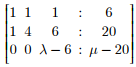
Apply R3⟶R3 – R2
For equation to have solution, rank of A and A:B must be same. Thus for no
solution; λ = 6, μ ≠ 20
Q10. A fair dice is tossed two times. The probability that the second toss results in a value that is higher than the first toss is
Answer : Option C
Explaination / Solution:
Total outcome are 36 out of which favorable outcomes are :
(1, 2), (1, 3), (1, 4), (1, 5), (1, 6), (2, 3), (2, 4), (2, 5), (2, 6);
(3, 4), (3, 5), (3, 6), (4, 5), (4, 6), (5, 6) which are 15.
P(E) = (No of favourable outcomes/No of total outcomes) = 15/36
= 5/12