Electrical Engineering - Online Test
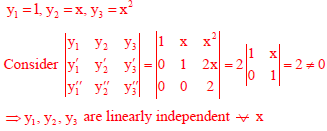
Q1. Consider the following statement about the linear dependence of the real valued functions y1 =
1, y2 = x and y3 = x2, over the field of real numbers.
I. y1, y2 and y3 are linearly independent on -1 ≤ x ≤ 0
II. y1, y2 and y3 are linearly dependent on 0 ≤ x ≤ 1
III. y1, y2 and y3 are linearly independent on 0 ≤ x ≤ 1
IV. y1, y2 and y3 are linearly dependent on -1 ≤ x ≤ 0
Which one among the following is correct?
Answer : Option B
Explaination / Solution:
Q2. Consider the sequence x[n] = anu[n] + bnu[n], where u[n] denotes the unit-step sequence and 0 < |a| < |b| < 1. The region of convergence (ROC) of the z-transform of x[n] is
Answer : Option B
Explaination / Solution:
No Explaination.
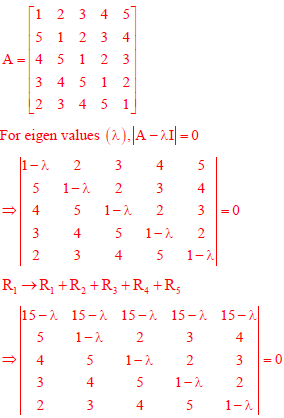
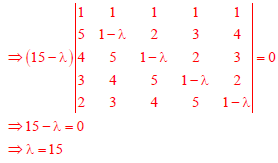
Q3. Consider the 5 × 5 matrix
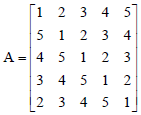
It is given that A has only one real eigen value. Then the real eigen value of A is
Answer : Option C
Explaination / Solution:
Q4. A closed-loop control system is stable if the Nyquist plot of the corresponding open-loop transfer function
Answer : Option A
Explaination / Solution:
No Explaination.
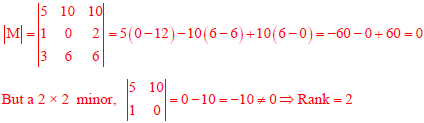
Q5. The rank of the matrix M =  is
is
is
Answer : Option C
Explaination / Solution:
Q6. A periodic signal x(t) has a trigonometric Fourier series expansion 
If  we can conclude that
we can conclude that
Answer : Option A
Explaination / Solution:
If x(t) = -x(-t) the given periodic signal is odd symmetric. For an odd symmetric signal an = 0 for all n.
If x(t) = -x(t- π/𝜔0), π/𝜔0 = T0/2 where T0 is fundamental period then the given condition satisfies half-wave symmetry.
For half-wave symmetrical signal all coefficients an and bn are zero for even value of n.
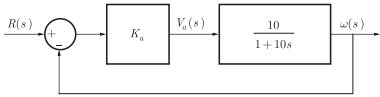
Q7. The open-loop transfer function of a dc motor is given a 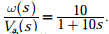 When connected in feedback as shown below, the approximate value of Ka that
will reduce the time constant of the closed loop system by one hundred times as
compared to that of the open-loop system is
When connected in feedback as shown below, the approximate value of Ka that
will reduce the time constant of the closed loop system by one hundred times as
compared to that of the open-loop system is
When connected in feedback as shown below, the approximate value of Ka that
will reduce the time constant of the closed loop system by one hundred times as
compared to that of the open-loop system is
Answer : Option C
Explaination / Solution:
No Explaination.
Q8. Which one of the following is the general solution of the first order differential equation 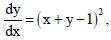 where x, y are real?
where x, y are real?
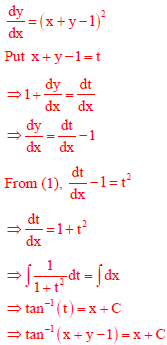
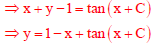
Answer : Option D
Explaination / Solution:
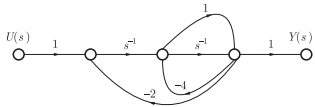
Q9. The signal flow graph for a system is given below. The transfer function Y(s)/U(s) for this system is
Answer : Option A
Explaination / Solution:
No Explaination.
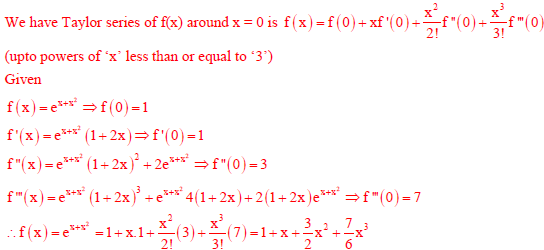
Q10. Let  for real x. From among the following, choose the Taylor series approximation of f(x) around x = 0, which included all powers of x less than or equal to 3.
for real x. From among the following, choose the Taylor series approximation of f(x) around x = 0, which included all powers of x less than or equal to 3.
Answer : Option C
Explaination / Solution: