Electrical Engineering - Online Test
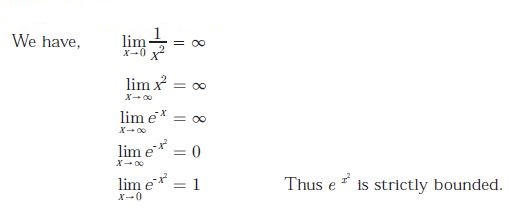
Q1. Which one of following functions is strictly bounded?
Answer : Option D
Explaination / Solution:
Q2.
Let x(t) be the input and y(t) be the output of a continuous time system.
Match the system properties P1, P2 and P3 with system relations R1, R2, R3, R4
Properties Relations
P1 : Linear but NOT time - invariant R1 : y(t) = t2x(t)
P2 : Time - invariant but NOT linear R2 : y(t) = t|x(t)|
P3 : Linear and time - invariant R3 : y(t) = |x(t)|
R4 : y(t) = x(t-5)
Answer : Option B
Explaination / Solution:
Mode function are not linear. Thus y(t) = |x(t)| is not linear but this functions is
time invariant. Option (A) and (B) may be correct.
The y(t) = t|x(t)| is not linear, thus option (B) is wrong and (a) is correct. We
can see that
R1 : y(t) = t2x(t) Linear and time variant.
R2 : y(t) = t|x(t)| Non linear and time variant.
R3 : y(t) = |x(t)| Non linear and time invariant.
R4 : y(t) = x(t-5) Linear and time invariant.
Q3. The amplitude of a random signal is uniformly distributed between -5 V and 5 V.If the signal to quantization noise ratio required in uniformly quantizing the signal is 43.5 dB, the step of the quantization is approximately
Answer : Option C
Explaination / Solution:
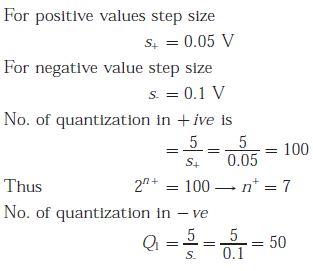
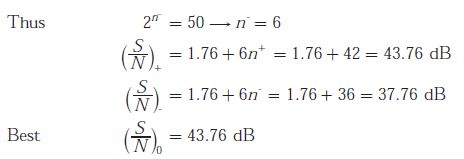
Q4. A speed signal, band limited to 4 kHz and peak voltage varying between +5 V and -5 V, is sampled at the Nyquist rate. Each sample is quantized and represented by 8 bits.
Assuming the signal to be uniformly distributed between its peak to peak value, the signal to noise ratio at the quantizer output is
Answer : Option C
Explaination / Solution:

Q5. 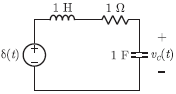
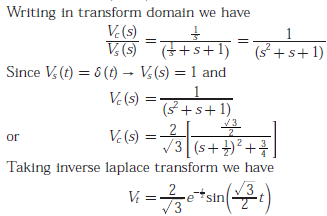
The following series RLC circuit with zero conditions is excited by a unit impulse functions 𝛿(t).
For t > 0, the output voltage vc(t) is
Answer : Option D
Explaination / Solution:
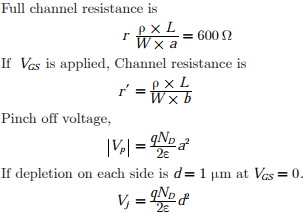
Q6. The channel resistance of an N-channel JFET shown in the figure below is 600Ω when the full channel thickness (tch) of 10μm is available for conduction. The
built-in voltage of the gate P+ N junction (Vbi) is -1 V. When the gate to source
voltage (VGS) is 0 V, the channel is depleted by 1 μm on each side due to the built
in voltage and hence the thickness available for conduction is only 8 μm
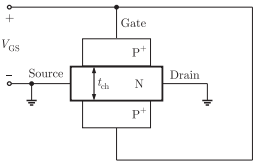
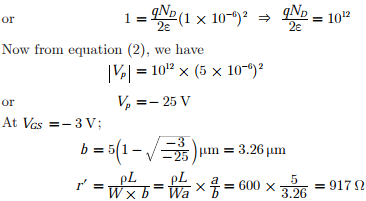
The channel resistance when VGS = -3 V is
Answer : Option B
Explaination / Solution:
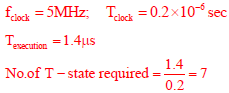
Q7. The clock frequency of an 8085 microprocessor is 5 MHz. If the time required to execute an instruction is 1.4 μs, then the number of T-states needed for executing the instruction is
Answer : Option C
Explaination / Solution:
Q8. For the function ex , the linear approximation around x = 2 is
Answer : Option A
Explaination / Solution:
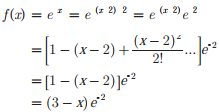
Neglecting higher powers
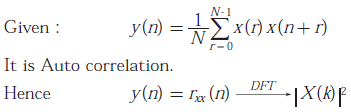
Q9. { x(n)} is a real - valued periodic sequence with a period N . x(n) and X(k) form N-point Discrete Fourier Transform (DFT) pairs. The DFT Y(k) of the sequence 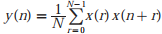 is
is
is
Answer : Option A
Explaination / Solution:
Q10. The maximum value of ᶿ until which the approximation sin ᶿ=ᶿ holds to within 10% error is
Answer : Option B
Explaination / Solution:
Here, as we know
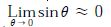
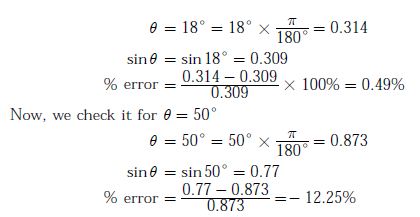
but for 10% error, we can check option (B) first
so, the error is more than 10%. Hence, for error less than 10%, ᶿ = 18º can have the approximation