Electrical Engineering - Online Test
Q1. For an analytic function, f(x + iy) = u(x,y) + iv(x,y), u is given by u = 3x2 - 3y2. The expression for v , considering K to be a constant is
Answer : Option D
Explaination / Solution:
No Explaination.
Q2. The partial differential equation 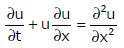 is a
is a
is a
Answer : Option D
Explaination / Solution:
No Explaination.
Q3. The eigen values of symmetric matrix are all
Answer : Option C
Explaination / Solution:
No Explaination.
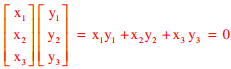
Q4. Consider a 3 × 3 real symmetric matrix S such that two of its eigen values are a ≠ 0, b ≠ 0 with respective eigenvectors  . If a ≠ b then x1y1 + x2y2 + x3y3 equals
. If a ≠ b then x1y1 + x2y2 + x3y3 equals
Answer : Option D
Explaination / Solution:
We know that the Eigen vectors corresponding to distinct Eigen values of real symmetric
matrix are orthogonal.
Q5. If a function is continuous at a point,
Answer : Option D
Explaination / Solution:
No Explaination.
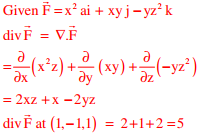
Q6. Divergence of the vector field 
Answer : Option C
Explaination / Solution:
Q7. An analytic function of a complex variable z = x + iy is expressed as f(z) = w(x, y) + iv(x, y),
where i = √−1. If u(x, y) = x2 – y2, then expression for v(x, y) in terms of x, y and a general
constant c would be
Answer : Option C
Explaination / Solution:
Given f(z) = w(x, y) + iv(x, y), is analytic and x = x2 - y2
We know that if f(z) = µ+iv is analytic then C-R equations will be satisfied.
∂µ/∂x = ∂v/∂xy and ∂µ/∂y = -∂v/∂x
v = 2xy + c is correct answer
Q8. Consider two solutions x(t) = x1(t) and x(t) and x(t) = x2(t) of the differential equation  The Wronskian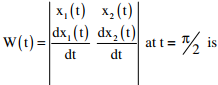
The Wronskian
Answer : Option A
Explaination / Solution:
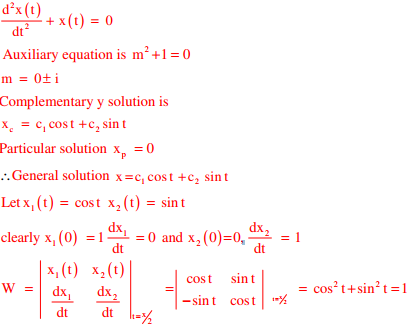
Given Differential equation is
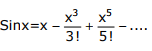
Q9. A series expansion for the function sinθ is
Answer : Option B
Explaination / Solution:
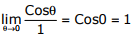
Q10. What is  equal to?
equal to?
Answer : Option D
Explaination / Solution:
Applying L’ Hospitals rule, we have