Physics - Online Test
Q1. Eight dipoles of charges of magnitude e are placed inside a cube. The total electric flux coming out of the cube will be
Answer : Option C
Explaination / Solution:
On all the dipoles net charge=0 so theotal electric flux coming out of the surface
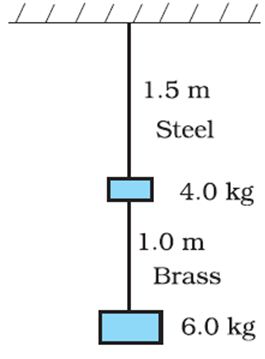
Q2. Two wires of diameter 0.25 cm, one made of steel and the other made of brass are loaded as shown in Figure The unloaded length of steel wire is 1.5 m and that of brass wire is 1.0 m. Compute the elongation of the steel wire.
Answer : Option C
Explaination / Solution:
No Explaination.
Q3. Two cylinders A and B of equal capacity are connected to each other via a stopcock. A contains a gas at standard temperature and pressure. B is completely evacuated. The entire system is thermally insulated. The stopcock is suddenly opened. Do the intermediate states of the system (before settling to the final equilibrium state) lie on its P-V-T surface?
Answer : Option C
Explaination / Solution:
Pressure and volume will be changed.
Q4. In which of the models, the positively charged part of the atom possesses most of the mass?
Answer : Option C
Explaination / Solution:
No Explaination.
Q5.
A truck starts from rest and accelerates uniformly at 2.0 m . At t = 10 s, a stone is dropped by a person standing on the top of the truck (6 m high from the ground). What is the magnitude of velocity (in m ) of the stone at t = 11s? (Neglect air resistance.)
Answer : Option C
Explaination / Solution:
During first 10 , the horizontal component of the velocity is vx = u + at = 0+2x10 = 20 m/s
From 10 to 11 s, the vertical component of the velocity is vy=u + gt = 0 + 10x1 = 10m/s
Relative velocity is,
Q6. A 6.0-kg block initially at rest is pulled to the right along a horizontal frictionless surface by a constant horizontal force of 12 N. Find the speed of the block after it has moved 3.0 m.
Answer : Option B
Explaination / Solution:
from work kinetic energy theorm
ΔK=W12mv2−12mu2=Fs(12×6×v2)−0=12×33v2=36v2=12v=3.5m/sec
Q7. The major contribution of S.N. Bose was in
Answer : Option D
Explaination / Solution:
Satyendra Nath Bose was an Indian physicist from Bengal specialising in theoretical physics. He is best known for his work on quantum mechanics in the early 1920s, providing the foundation for Bose–Einstein statistics and the theory of the Bose–Einstein condensate.
Q8. To make a condenser of 16 μF, 1000 volts, how many condensers are needed which have written on them “8 μF, 250 volts”?
Answer : Option D
Explaination / Solution:
Each capacitor of capacitance can withstand a maximum potential of 250 V. When equal capacitors are connected in series, the potential difference across them is equal. If there are m capacitors in series such that the potential across each is 250 V, then,. The equivalent capacitance of 4 capacitors connected in series is.To achieve a capacitance of 16 , n such rows of capacitors need to be connected in parallel. .To make a condenser of 16,8 rows of capacitors with each row containing 4 capacitors are to be connected. The total number of capacitors= n×m=4×8=32.
Q9. A spherical solid ball of 1 kg. mass and radius 3 cm is rotating about an axis passing through its centre with an angular velocity of 50 radians/s. The kinetic energy of rotation is
Answer : Option D
Explaination / Solution:
M=1KgR=3cm=3×10⁻²mω=50rad/sK=12Iω2=12×25MR2×ω2K=12×25×1×(3×10−2)2×50×50=920J
Q10. Soap helps in better cleansing of clothes because
Answer : Option B
Explaination / Solution:
Water molecules have a tendency to stick together, as opposed to losing their fellow water molecules’ company and sticking to other surfaces. This happens as a result of something known as the ‘surface tension’ of water.
Surfactants are substances that help lower the surface tension of water molecules, thus ‘persuading’ them to wet things more uniformly.
Soaps (which are a type of detergent) contain surfactants in significant amounts, which help water spread uniformly over clothes.