Physics - Online Test
Q1. A stone tied to the end of a string 80 cm long is whirled in a horizontal circle with a constant speed. If the stone makes 14 revolutions in 25 s, what is the magnitude and direction of acceleration of the stone?
Answer : Option C
Explaination / Solution:
Length of the string, l = 80 cm = 0.8 m
Number of revolutions = 14
Time taken = 25 s
Frequency,
Angular frequency,
=
Centripetal acceleration, ac = ω2r
=
= 9.9 ms-2
The direction of centripetal acceleration is always directed along the string, towards the centre, at all points.
Number of revolutions = 14
Time taken = 25 s
Frequency,
Angular frequency,
=
Centripetal acceleration, ac = ω2r
=
= 9.9 ms-2
The direction of centripetal acceleration is always directed along the string, towards the centre, at all points.
Q2. A metallic solid sphere is placed in a uniform electric field. In the figure, which path will the lines of force follow?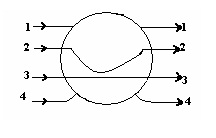
Answer : Option D
Explaination / Solution:
The electric field is always perpendicular to the surface of a conductor. On the surface of a metallic solid sphere, the electrical field is oriented normally (i.e. directed towards the centre of the sphere).so 4th line is correct.
Q3. A hydraulic press contains 0.25 (250 L) of oil. Find the decrease in the volume of the oil when it is subjected to a pressure increase = 1.6 Pa(about 160 atm or 2300 psi). The bulk modulus of the oil is B = 5.0 Pa
Answer : Option B
Explaination / Solution:
No Explaination.
Q4. Two cylinders A and B of equal capacity are connected to each other via a stopcock. A contains a gas at standard temperature and pressure. B is completely evacuated. The entire system is thermally insulated. The stopcock is suddenly opened. What is the change in the temperature of the gas?
Answer : Option C
Explaination / Solution:
Temperature remains constant because system is thermally insulated. so that change in temperature will be zero.
Q5. In which of the models An atom has a highly non-uniform mass distribution?
Answer : Option C
Explaination / Solution:
No Explaination.
Q6. A body of mass 0.40 kg moving initially with a constant speed of 10 m /s to the north is subject to a constant force of 8.0 N directed towards the south for 30 s. Take the instant the force is applied to be t = 0, the position of the body at that time to be x = 0, and predict its position at t = –5 s.
Answer : Option B
Explaination / Solution:
Let ,
At t= -5 s, there is no force acting on the particle,
so,
Q7. A rain drop of mass 2.00 g falls from a height 1.00 km. It hits the ground with a speed of 50.0 m/s. What is the work done by the gravitational force? (Take g = 10 m )
Answer : Option C
Explaination / Solution:
W=Fscosθ=mghcos0∘W=2×10−3×10×1000×1=20J
Q8. The major contribution of M.N. Saha was
Answer : Option C
Explaination / Solution:
Meghnad Saha was an eminent Indian astrophysicist who gave the world the theory of ionization which explained the origin of stellar spectra.
Q9. For a charged conductor of arbitrary shape, inside the conductor
Answer : Option C
Explaination / Solution:
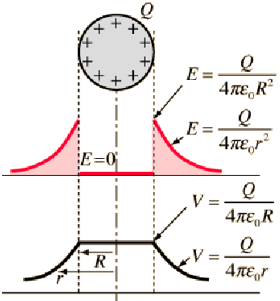
The electric field on the surface of a hollow conductor is maximum and it drops to zero abruptly inside the conductor. Since, the potential difference between any two points inside the hollow conductor is zero. This means that the potential at all points inside the hollow charged conductor is same and it is equal to the value of the potential at its surface.
Q10. Which of the following has the largest moment of inertia?
Answer : Option A
Explaination / Solution:
Hence ring has largest moment of inertia.