Physics - Online Test
Q1. In a photon-particle collision (such as photon-electron collision) the quantity which is not conserved is
Answer : Option B
Explaination / Solution:
No Explaination.


Q2. TV set used in a typical house is
Answer : Option D
Explaination / Solution:

The equipment that sends out a radio wave is known as a transmitter; the radio wave sent by a transmitter whizzes through the air—maybe from one side of the world to the other—and completes its journey when it reaches a second piece of equipment called a receiver.A television antenna, or TV aerial, is an antenna specifically designed for the reception of over-the-air broadcast television seignal, which are transmitted at frequencies from about 41 to 250 MHz in the VHF band, and 470 to 960 MHz in the UHF band in different countries..

Q3. The path of a projectile is
Answer : Option D
Explaination / Solution:

A particle with a vertical and horizontal velocity travelling in a gravitational field will trace out a parabola.

Q4. mass and energy are equivalent and are related by
Answer : Option A
Explaination / Solution:

Mass–Energy equivalence states that anything having mass has an equivalent amount of energy and vice versa, with these fundamental quantities directly relating to one another by Einstein's theory of special relativity. It shows that matter (as mass) and energy can be converted into each other according to the famous equation 
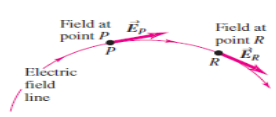
Q5. At any point on S on an electric field line
Answer : Option B
Explaination / Solution:

When a tangent is drawn at any point on field line then that tangent gives the direction of electric field at that point


Q6. Young’s modulus Y is
Answer : Option A
Explaination / Solution:

The ratio of stress and strain is called modulus of elasticity is the characteristic of the material. they are (a) Young's modulus (b) Shear Modulus (c) Bulk modulus

Young's Modulus is denoted by Y and is given by  the ratio of tensile (or compressive) stress (σ)" role="presentation" style="display: inline; line-height: normal; word-spacing: normal; word-wrap: normal; white-space: nowrap; float: none; direction: ltr; max-width: none; max-height: none; min-width: 0px; min-height: 0px; border: 0px; padding: 0px; margin: 0px; position: relative;"> to the longitudinal strain (ε)" role="presentation" style="display: inline; line-height: normal; word-spacing: normal; word-wrap: normal; white-space: nowrap; float: none; direction: ltr; max-width: none; max-height: none; min-width: 0px; min-height: 0px; border: 0px; padding: 0px; margin: 0px; position: relative;">

Y = tensile stress/longitudinal strain

Y=σ/ϵ" role="presentation" style="display: inline; line-height: normal; word-spacing: normal; word-wrap: normal; white-space: nowrap; float: none; direction: ltr; max-width: none; max-height: none; min-width: 0px; min-height: 0px; border: 0px; padding: 0px; margin: 0px; position: relative;">


Q7. The heat engine takes
Answer : Option A
Explaination / Solution:

a heat engine converts heat energy to mechanical work by using the temperature difference between a hot "source" and a cold "sink". Heat is transferred from the source, through the "working body" of the engine, to the "sink", and in this process some of the heat changes into work by using the qualities of the gas or liquid inside the engine.

Q8. Which of these statements about De Broglie Explanation of Bohr model is correct?
Answer : Option C
Explaination / Solution:
No Explaination.


Q9. To get the law of free fall under gravity, it is better
Answer : Option D
Explaination / Solution:

In ohysics, we can neglect some small forces, quantities and calculation.

Q10. Rolling friction is
Answer : Option D
Explaination / Solution:

As the area of contact is less in the case of rolling than in the case of sliding. In rolling surface of contact do not rub each other. The velocity of the point of contact with respect to the surface remains zero all the time although the Centre of mass of the wheel moves forward. Hence rolling friction is negligible in comparison to static friction.