Physics - Online Test

Q1. In Digital type signals, signals can take
Answer : Option D
Explaination / Solution:
No Explaination.


Q2. The work done by a conservative force
Answer : Option A
Explaination / Solution:

A force is said to be conservative if work done by this force is independent of path and is dependent only on end points .

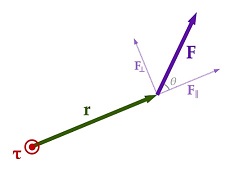
Q3. Torque τ is defined in terms of position vector r and the force acting F as
Answer : Option D
Explaination / Solution:

Torque = Force x Perpendicular distance of the line of action of the force from the axis of rotation. It is also called moment of force.

 torque is defined as the cross product of the vector by which the force's application point is offset relative to the fixed suspension point (distance vector) and the force vector, which tends to produce rotational motion.


Q4. A unit vector is a vector
Answer : Option D
Explaination / Solution:

A unit vector in a normed vector space is a vector (often a spatial vector) of length 1. A unit vector is often denoted by a lowercase letter with a circumflex, or "hat":  (pronounced "i-hat"). The term direction vector is used to describe a unit vector being used to represent spatial direction.

a unit vector directed along the positive x axis

= a unit vector directed along the positive y axis

 = a unit vector directed along the positive z axis


Q5. The unit of charge is
Answer : Option C
Explaination / Solution:

The SI unit of quantity of electric charge is the coulomb, which is equivalent to about 6.242×10¹⁸ e (e is the charge of a proton).

Hence, the charge of an electron is approximately −1.602×10⁻¹⁹ C. The coulomb is defined as the quantity of charge that has passed through the cross section of an electrical conductor carrying one ampere within one second. The symbol Q is often used to denote a quantity of electricity or charge.
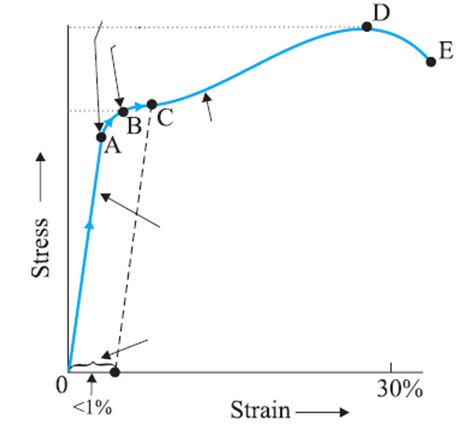

Q6. With reference to figure the yield point corresponds to

Answer : Option D
Explaination / Solution:
No Explaination.


Q7. In Thermodynamics Extensive variables depend
Answer : Option D
Explaination / Solution:

The variables which depend on the size or amount of the substance are called extensive variables. Example: Mass, volume etc

Q8. To produce an emission spectrum of hydrogen
Answer : Option D
Explaination / Solution:
No Explaination.


Q9. Proper framework for explaining microscopic phenomena is
Answer : Option C
Explaination / Solution:

Quantum mechanics (QM -- also known as quantum physics, or quantum theory) is a branch of physics which deals with physical phenomena at nanoscopic scales where the action is on the order of the Planck constant. It departs from classical mechanics primarily at the quantum realm of atomic and subatomic length scales.

Q10. According to Newton's third law of motion, the action and reaction forces are
Answer : Option A
Explaination / Solution:

When one body exerts a force on a second body, the second body simultaneously exerts a force equal in magnitude and opposite in direction on the first body.To every action there is always opposed an equal reaction or the mutual actions of two bodies upon each other are always equal and opposite in direction.