Physics - Online Test
Q1. work-energy theorem does not give information on
Answer : Option D
Explaination / Solution:
According to work energy theorem :
Net work done on a body equals change in its kinetic energy
So it does not give any information about time dependence.
Q2. Any physical quantity like temperature can be converted to
Answer : Option A
Explaination / Solution:
An electrical transducer is a device which is capable of converting the physical quantity into a proportional electrical quantity such as voltage or electric current. Hence it converts any quantity to be measured into usable electrical signal. This physical quantity which is to be measured can be pressure, level, temperature, displacement etc. The output which is obtained from the transducer is in the electrical form and is equivalent to the measured quantity. For example, a temprature transducer will convert temperature to an equivalent electrical potential. This output signal can be used to control the physical quantity or display it.moreover this is of two type Digital or Analog electrical signals.
Q3. The moment of inertia of a body about any axis is
Answer : Option D
Explaination / Solution:
according to parallel axis theorem the moment of inertia of a body about any axis is equal to the sum of the moment of inertia of the body about a parallel axis passing through its Centre of mass and the product of its mass and the square of the distance between the two parallel axes.
Q4. We can define the difference of two vectors A and B as the
Answer : Option A
Explaination / Solution:
Vector subtraction is defined in the following way.
- The difference of two vectors, A - B , is a vector C that is, C = A - B
- The addition of two vector such that C = A + (-B). B has been taken in opposite direction.
Thus vector subtraction can be represented as a vector addition.
Q5. In charging by Induction
Answer : Option B
Explaination / Solution:
If a charged object placed near an uncharge object than redistribution of charge takes place in uncharge object and if we will earthed one surface of uncharged object than one charge goes to earth and other charge spread on its surface and it becomes charged.
Q6. With reference to figure the elastic zone is
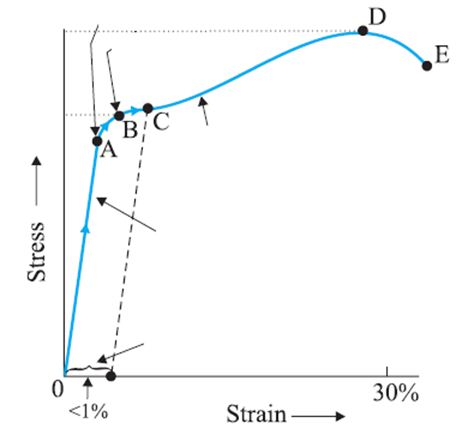
Answer : Option B
Explaination / Solution:
No Explaination.
Q7. For solids near room temperature the molar specific heat (R is the universal gas constant)
Answer : Option B
Explaination / Solution:
The molar specific heats of solids also demonstrate a marked temperature dependence. Solids have molar specific heats that generally decrease in a nonlinear manner with decreasing temperature and approach zero as the temperature approaches absolute zero. At high temperatures (usually above 300 K), the molar specific heats approach the value of 3R ≈ 25 J/mol.K, a result known as the DuLong–Petit law.
Q8. Emission line spectrum of atoms contains
Answer : Option C
Explaination / Solution:
No Explaination.
Q9. The microscopic domain of physics deals with
Answer : Option C
Explaination / Solution:
Microscopic domain includes atomic,molecular and nuclear phenomena. It can be said as the study of matter.It includes the study of structure and configuration of atom,nucleus and the constitute particles of atom-electron,proton,neutron and interaction with elementary particles like electron,photon etc.
Q10. Impulse is a
Answer : Option D
Explaination / Solution:
Since force is a vector quantity, impulse is also a vector in the same direction.
Impulse J produced from time t1 to t2 is defined to be
where F is the resultant force applied from t1 to t2
force is related to momentum p by
F = dp/dt
therefore,
where is the change in linear momentum from time t1 to t2