Physics - Online Test
Q1. In which case is the work done zero?
Answer : Option D
Explaination / Solution:
Work done is given as
W = Fdcos
Here is the angle between F and d if both are perpendicular then = 90 degree so cos = 0 and thus work done is 0 .
Q2. Which of these is an acoustic transducer?
Answer : Option D
Explaination / Solution:
Acoustic transducer is a device which converts one form of signal into another without any direct contact.
Q3. Vector addition is
Answer : Option B
Explaination / Solution:
Vector addition is commutative, just like addition of real numbers. If you start from a point say P, you end up at the same spot no matter which displacement (a or b) you take first. The head-to-tail rule yields vector c for both a + b and b + a.
Q4. Ionization of a neutral atom is the
Answer : Option A
Explaination / Solution:
It is not possible to remove or add protons to atom, but electron can be added or removed by an atom easily so charge can be developed on an atom by removing or adding electrons, by adding electrons it becomes negative charged ,by removing electrons it becomes positive charged.
Q5. Referring to figure shearing strain is defined as.
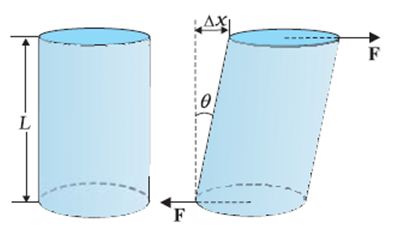
Answer : Option A
Explaination / Solution:
No Explaination.
Q6. Internal energy of a system is
Answer : Option D
Explaination / Solution:
A state function describes the equilibrium state of a system. For example, internal energy, enthalpy, and entropy are state quantities because they describe quantitatively an equilibrium state of a thermodynamic system, irrespective of how the system arrived in that state.
Q7. Heliocentric theory proposed by Nicolas Copernicus was
Answer : Option B
Explaination / Solution:
Copernican heliocentrism is the name given to the astronomical model developed by Nicolaus Copernicus and published in 1543. It positioned the Sun near the center of the Universe, motionless, with Earth and the other planets rotating around it in circular paths modified by epicycles and at uniform speeds.
This theory was replaced by Keplar. All planets move in elliptical orbits, with the sun at one focus. This is one of Kepler's laws. The elliptical shape of the orbit is a result of the inverse square force of gravity. The eccentricity of the ellipse is greatly exaggerated here.
Q8. The model that best explains the results of Geiger-Marsden experiment is
Answer : Option D
Explaination / Solution:
No Explaination.
Q9. The second law of motion is a vector law. It is equivalent toFx=max,Fy=may,Fz=maz
Answer : Option B
Explaination / Solution:
No Explaination.
Q10. Average power supplied to a capacitor over one complete cycle
Answer : Option D
Explaination / Solution:
We know that in capacitor Current leads Voltage by 90degree. Over one complete cycle, in first quarter cycle Capacitor charges and next quarter cycle it's discharge. This will continue in next negative half cycle. So the NET POWER ABSORB IS ZERO.