Physics - Online Test
Q1. According to Huygens construction relation between old and new wave fronts is
Answer : Option C
Explaination / Solution:
No Explaination.


Q2. Compass needle of known magnetic moment m in a uniform magnetic field field experiences a torque equal to
Answer : Option D
Explaination / Solution:
No Explaination.


Q3. A ‘central’ force is always directed
Answer : Option B
Explaination / Solution:

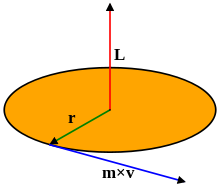
The motion of a particle under a central force F always remains in the plane defined by its initial position and velocity.This may be seen by symmetry. Since the position r, velocity v and force F all lie in the same plane, there is never an acceleration perpendicular to that plane, because that would break the symmetry between "above" the plane and "below" the plane.

To demonstrate this mathematically, it suffices to show that the angular momentum of the particle is constant. This angular momentum L is defined by the equation


Q4. Motion of hole is a convenient way of describing
Answer : Option A
Explaination / Solution:

The holes are just the abscence of a electron in a energy band. But its easier to describe the abscence of a electron as a single moving positive charge than it is to describe the motion of all the other electrons in the band. In a band you have N electrons. Remove one of those electrons(by for instance p-doping) and you have N-1 electrons left. Now you can either choose to describe this with the behavior of those N-1 electrons. Or you can choose to describe it as if there is one single hole moving around in the band. So mathematicly the holes behave just like a positivly charged electron.

Q5. For one dimensional motion displacement is the
Answer : Option C
Explaination / Solution:

Displacement is defined to be the change in position of an object. It can be defined mathematically with the following equation:


 refers to the value of the final position.

 refers to the value of the initial position.

 is the symbol used to represent displacement.


Q6. Angular frequency ω and wave vector k are related by
Answer : Option D
Explaination / Solution:
No Explaination.


Q7. in longitudinal waves, the constituents of the medium
Answer : Option D
Explaination / Solution:

In longitudinal wave motion, medium particles oscillates or vibrates in same direction of wave propagation to produce compression & rarefaction in wave propagation.

Q8. According to Farady's law for a coil having N turns, the total induced emf is given by
Answer : Option C
Explaination / Solution:

The induced electromotive force in any closed circuit is equal to the negative of the time rate of change of the magnetic flux enclosed by the circuit.

induced emf for a coil having 1 turns will be 

The flux of all the turns will be added up. So the induced emf for a coil having N turns will be 

Q9. Stopping potential in the experimental set up shown in figure is 

Answer : Option A
Explaination / Solution:

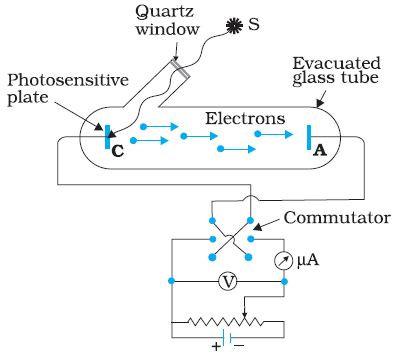
The negative potential of the plate at which the photo electric current becomes zero is called stopping potential or cut-off potential. Its value is negative because some electron reach to the plate with their kinetic energy at zero potential.

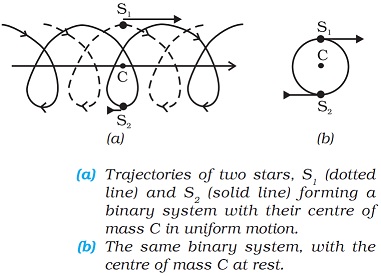
Q10. considering binary (double) stars in our frame of reference, the trajectories of the stars are a combination of
Answer : Option B
Explaination / Solution:

A double star or visual double is a pair of stars that appear close to each other in the sky as seen from Earth when viewed through an optical telescope.

In absence of  external force Centre of mass of double star moves like a free particle. In Centre of mass frame both stars moving in a circle about the Centre of mass which is at rest and both star are diametrically opposite to each other.

Thus in our frame of reference, the trajectories of the stars are a combination of (i) uniform motion in a straight line of the Centre of mass and        (ii) circular orbits of the stars about the Centre of mass.