Physics - Online Test

Q1. Which of the following is a possible final step in applying the scientific method
Answer : Option C
Explaination / Solution:

Your experiment tests whether your prediction is accurate and thus your hypothesis is supported or not. It is important for your experiment to be a fair test. You conduct a fair test by making sure that you change only one factor at a time while keeping all other conditions the same. You should also repeat your experiments several times to make sure that the first results weren't just an accident.

Q2. The change in kinetic energy of a particle is equal to the
Answer : Option A
Explaination / Solution:

if a body of mass m move with velocity u under the action of force F. Its velocity become v after displaced by s. then v2=u2+2as v2−u2=2as mv2−mu2=2mas 12mv2−12mu2=Fs Kf−Ki=W ΔK=W


Q3. Which of these is an example of broadcast communication?
Answer : Option C
Explaination / Solution:

In broadcast mode of communication a large number of receivers are linked to a single transmiiter.Radio works as receiver which converts the transmiited information/message into the original form of the information.

Q4.

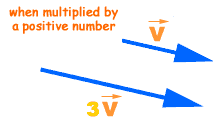
Multiplying a vector    by a positive real number 

Answer : Option D
Explaination / Solution:

When a vector is multiplied by a positive number (for example 2, 3 ,5, 60 unit etc.) or a scalar only its magnitude is changed but its direction remains the same as that of the original vector.

Q5. Conservation of charges in tribo electric charging
Answer : Option B
Explaination / Solution:

The triboelectric effect (also known as triboelectric charging) is a type of contact electrification in which certain materials become electrically charged after they come into frictional contact with a different material. Rubbing glass with fur, or a plastic comb through the hair, can build up triboelectricity.

When we charge something with static electricity, no electrons are made or destroyed. No new protons appear or disappear. Electrons are just moved from one place to another. The net, or total, electric charge stays the same. This is called the principle of conservation of charge.

If a glass rod is rubbed with silk, some electrons moves from glass rod to silk no new charge is generated or destroyed.


Q6. Stress is
Answer : Option B
Explaination / Solution:
No Explaination.


Q7. Diathermic wall is
Answer : Option C
Explaination / Solution:

A wall which prevents thermal interaction is known as adiabatic wall and a system enclosed within an adiabatic wall is called thermally isolated. If exchange of heat takes place between the system and surroundings through the boundary wall, the boundary is called diathermic wall.

Q8. In Geiger-Marsden experiment prediction was that
Answer : Option A
Explaination / Solution:
No Explaination.


Q9. According to Newton's second law of motion
Answer : Option B
Explaination / Solution:

If mass does not change then acceleration of a particle is dependent on the forces acting upon the particle and the particle's mass. For a given particle, if the net force is increased, the acceleration is increased. For a given net force, the more mass a particle has, the less acceleration it has.

F=ma=mdvdt=d(mv)dt=dpdt.

hence the rate of change of momentum of a body is directly proportional to the applied force


Q10. If  is the maximum current, then the average value of power dissipated in a resistance R over a cycle is
Answer : Option B
Explaination / Solution:

As in the case with DC power, the instantaneous electric power in an AC circuit is given by P = VI, but these quantities are continuously varying. So the average power is given by

Pavg = VI cosφ

where φ is the phase angle between the current and the voltage and where V and I are understood to be the effective or rms values of the voltage and current.

Now RMS value of I is = 

So, RMS value of V= 

Therefore, Power will be

P=           (because cosφ= 1 for circuit containing resistance only)